


Learners Live

Perth Concert Hall Successfully Completes LED Lighting Upgrade

Perth Concert HallUK – Perth Concert Hall has taken a significant step towards sustainability and modernisation with the completion of its ‘Lights-Up Perth Concert Hall’ project, which saw the replacement of its tungsten lighting system with an advanced LED set-up. Spearheaded by Stage Electrics, this upgrade marks a new era for the venue, enhancing both its environmental credentials and artistic capabilities. The switch from tungsten to LED lighting has provided Perth Concert Hall with numerous benefits. LED lights consume up to 80% less power, generate less heat and have a longer lifespan, resulting in lower maintenance and operational costs. The new system also offers enhanced flexibility, with instant and precise colour changes, smoother dimming and dynamic effects such as strobes and fades that were previously unattainable. Perth Concert Hall Successfully Completes LED Lighting Upgrade – LEDinside
EC&M’s Illumination Insider

If you are not getting this online lighting resource, think about it.  Here is the content today:

Next-Generation Street Lighting Systems Support Smart Cities

LED Retrofits – Smart, Sustainable, and Good for Business

The Lagging Transition to LEDs in Schools – Part 1 of 3

How Can Lighting Scenes Enhance Indoor Spaces?

OUTDOOR LIGHTING | Light done right transforms public spaces

PROJECT | Layered illumination heightens luxury in hotel and living spaces

The Benefits of Tunable White Light

Demystifying IECC and ANSI/ASHRAE/IES Lighting and Control Requirements

Illumination Insider – Nov 13th, 2024

Vertiberry Picks Sollum for Strawberries

Sustainable indoor farming group Vertiberry has announced that it has chosen Sollum’s LED lighting solution for its new facility in L’Assomption, Québec. Expected to be operational by the end of 2024, the indoor/TCEA facility will serve as a test bed for Vertiberry’s innovative growing methods, which include both strawberry propagation and production. Vertiberry said its decision to choose Sollum’s technology underscored its dedication to producing high-quality, pesticide-free strawberries year-round in a 100 per cent controlled environment. By working closely with Vertiberry, Sollum is looking to ensure the lighting solution supports their cultivation methods, resulting in higher yields and energy efficiency.  Vertiberry picks Sollum for strawberries – LEDinside

Trump Return Likely to Slow, Not Stop, US Clean-Energy Boom

Donald Trump’s return to the White House will refocus the nation’s energy policy onto maximizing oil and gas production and away from fighting climate change, but the Republican win in Tuesday’s presidential election is unlikely to dramatically slow the U.S. renewable energy boom. Renewable energy sources such as solar and wind are the fastest-growing segments on the power grid, according to the Department of Energy, driven by federal tax credits, state renewable-energy mandates, and technology advancements that have lowered their costs. Trump return likely to slow, not stop, US clean-energy boom | Reuters

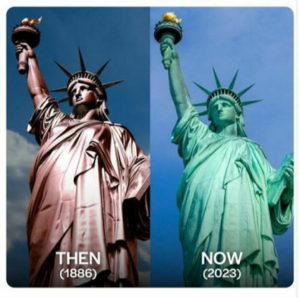
The Statue of Liberty was made with copper but due to oxidation, it turned green.

When the “Lady in the Harbor” first arrived in New York in 1886, she didn’t look like the mint-green icon we know today. In fact, for the first twenty years of her life, she stood as a towering, metallic beacon of reddish-gold. Designed by French sculptor Frédéric Auguste Bartholdi and engineered by Alexandre Gustave Eiffel, the statue was a gift from France to America. To build her, Bartholdi chose copper for three practical reasons:

  • Malleability:It could be hammered into elaborate, thin sheets.
  • Weight:Copper is lighter than stone or bronze, making it easier to ship 350 individual pieces across the Atlantic.
  • Durability:It was strong enough to survive a 27-day ocean voyage and the harsh winds of the harbor.

When she was unveiled on October 28, 1886, her skin—made of 300 copper sheets roughly the thickness of two pennies—shone with a bright, metallic brown luster. The transformation from “penny-colored” to “patina-green” wasn’t planned. Bartholdi actually expected the statue to age into a deeper, darker red. However, the unique environment of New York Harbor—a mix of salt air, moisture, and industrial pollution—triggered a process called oxidation.

The Timeline of Change:

  1. 1886–1900:The bright copper dulled into a dark, muddy brown.
  2. 1903:The first hints of a light green crust, or “patina,” began to appear.
  3. 1906:The color change was so controversial that Congress nearly stepped in. They appropriated $62,000 to paint the statue back to its original color, but the public protested, calling the idea “sacrilege.”
  4. 1910–1920:The statue was a patchy mix of brown and green until 1920, when the oxidation was complete, leaving her entirely teal.

While we now view the green color as iconic, it actually serves a vital structural purpose. The layer of verdigris (the green patina) acts as a protective shield. It seals the copper underneath, preventing the metal from further corrosion and weathering.  By the time the color fully changed, a new generation of immigrants had arrived in America seeing a green statue.