Learners Live

Learners vs. Learned by Bill Attardi

Learners possess certain attributes that distinguish them from the learned. They anticipate rather than react to change.  Some call that vision. They become essential facilitators of change within their altered environment. They can skillfully communicate the new and technically esoteric with a clarity that leads to understanding and advocacy. Organizations that don’t value learning and the change that springs from learning will struggle to stay relevant in this fast-paced ever-changing marketplace.

Learners influence change in an organization and, in turn, their leaders allow people to adapt to that change.  As an Educator, my ambition here is to express my view that education, the learning process, is not a one-time event but rather, something you do all the time.  Sounds a lot like Vince Lombardi when he talked about doing things right, not once in a while but all the time, right?  Winning is everything… remember that?

College students are there to learn, to prepare for a life of success in a leadership role with an organization of their instigation or rather, maybe one of their choosing.  In my undergraduate classes, especially when they are mostly seniors, and certainly in my graduate classes at Monmouth University, I congratulate them for the progress they have made so far in their collegiate work as learners and no matter the future, each and every one of them has earned the right to be called highly competent individuals……as long as they continue to nourish the learning process.

Eric Hoffer observed, “In times of change learners inherit the earth; while the learned find themselves beautifully equipped to deal with a world that no longer exists.”

Content Marketing Goes Mobile by Bill Attardi

In this high-tech digital age, we are all addicted to our machines and devices. Hard to teach our kids to put down that smart phone or stop with the social media jazz when we are so dependent on it too. That’s where we are, so what do we do about it?

Mobile has become today’s brave new marketing frontier, especially for offerings courting younger consumers. Mobile devices are very personal, ever-present, and always on. That makes them an ideal medium for obtaining quick responses to individualized, time-sensitive offers when moments matter. No question, our mobile devices dominate our interactive lives, and you don’t have to be a millennial to know it. So what do you think, are they important to our content marketing strategies? Should they be? Maybe you noticed, we now call it a SmartPhone. What is that? Why do we still call it a “phone” at all when only 10% of the time it is used as a long-distance communication device, per Alexander Graham Bell.

Allow me to explain (mi spiego in Italian), content marketing is the practice of sharing content relevant to your target audience to build trusting relationships, increasing brand awareness, certainly sales, engagement, and loyalty. Compelling content may include any media created with the intent of educating or entertaining your audience and the content that you put out into the world is more important than ever. Mobile devices will dominate content marketing strategies, because almost everyone in the world has them.

Our business is changing your future… Not unlike traditional marketing, mobile content marketing is meant to build brand loyalty to your products, improve engagement with your customers, and still most certainly to increase sales. We teach at the graduate level that going mobile doesn’t mean just putting your marketing plan on a smaller screen. All of us, even the non-millennials, are running around, in a hurry, moving & shaking, on the go and want things quickly and hassle-free. Access is king!

If you buy in so far, my suggestion is that mobile content marketing must do these things:

  1. Content must be SIMPLE: a clear and simple call to action. You just cannot get all the content you want on a mobile screen. You really have to be good at more with less. Focus on messages that entice them to download your app, or to view that video that visually sells your value proposition, or to click on that link with more detailed content. Your target audience is most likely walking and/or talking when they get a glimpse of your text or tweet, so don’t make them overthink it. Just tell them the one thing you want them to do, and if there is a need, they’ll do it.
  1. Must be QUICK: instant gratification is just not quick enough these days. Download now. Watch the video now. Visit our website now. Order now. Provide a link that is quick and easy to access. A quick effective message is all you need to get their attention and the desired response. Even the larger mobile screens can’t handle a lot of stuff, so don’t overload it. 
  1. Must create RELEVANCY: how many emails, text messages, tweets, posts, ads do you get every day? With me, it’s hundreds… it’s getting harder and harder to access the things we actually care about. Things I don’t care about get directed to the junk file. Make sure your content doesn’t suffer this fate. The best way to be relevant is to think about what people do on their devices. Are you talking to your target audience that need your products and services? Are you solving problems, not just selling stuff? Do you matter to your mobile users? If you do, they will listen….
  1. Integrated Marketing Communications (IMC): bring it all together in a clear, organized way. Carefully integrate and coordinate the content message about the organization and offering across the many communications channels, not only your target customers but to your employees and stakeholders as well. Engage, entertain, inform and persuade to action…..
  1. Must measure the RESULTS: it’s a digital game….the analytics are there. Evaluate how you are doing. Open rate, hits, click rate, unique clicks, visitors: new & returning, referrals, SEO, etc. Do more of what works, change what doesn’t. Very important in the era of Big Data. Oh, hire a Millennial…

A Leader Is as a Leader Does: Leadership styles, traits, skills and more by Donny Metcalf, Electrical Contractor

  Let’s set the scene. You are approached by your supervisor, who says management feels you are doing very well. You have the respect of the rest of the crew and are ready for a leadership role. The question becomes, what does that look like? What do you look like as a leader? 

Key leadership styles and traits 

If you are given the opportunity to prove yourself as a leader, it is likely because you are good at your job and someone saw potential in you. But before you can be an effective leader, there are some key leadership styles and traits to identify.

In my opinion, two distinctive styles of leadership stand out: transformational and transactional leaders. A transformational leader inspires and motivates the team to innovate and work toward the goal. This usually results in high-performing teams with high morale.

A transactional leader focuses more on structured goals and rewards. This type of leadership style emphasizes clearly defined roles and performance metrics. Everyone knows the part they play, what needs to be accomplished and what is expected. Things are more black and white.

Regardless of which type of leadership you choose to practice, below are a few traits all good leaders possess:

  • Professionalism—We should carry ourselves as professionals, from the way we talk (profanity is not necessary every other word) to the way we dress (consider wearing a shirt with a collar and buttons and a clean pair of khaki pants or jeans).
  • Compassion/empathy—Remember that we were once in our employees’ shoes. Understand that everyone is at different levels of experience.
  • Knowledge—Know the project and process for what you are trying to accomplish. As leaders, it is not necessary to have all the answers, but we must be willing to do some research and find them.
  • Dependability—A good leader strives to do what they say they will do.
  • Motivation—Be the person your team can look up to when times get tough.
  • Problem-solving—Be creative with solutions to problems, especially with more complex projects with shorter completion times. Think of them as chances for excellence.
  • Accountability—Leaders hold the overall accountability for a project’s results (whether good or bad). We also hold individual team members accountable for their portion of the work.

 And, one of the most important skills—and often the most neglected—in leadership is communication.  A Leader Is as a Leader Does: Leadership styles, traits, skills and more | Donny Metcalf – Electrical Contractor Magazine

Launch of LearnersLive.com in 2025 – Now the Plan for 2026 – A Passion for Learning by Bill Attardi

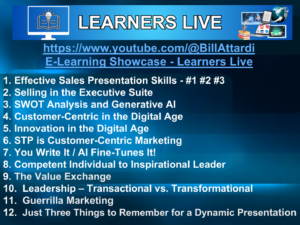
WELL, WE DID IT! We are now live on YouTube: https://www.youtube.com/@BillAttardi

And also on e-Learning Showcase:  https://learnerslive.com/education-showcase/

As promised we posted a virtual learning session every month in 2025:

  1. Effective Sales Presentation Skills – Learning Session #1, #2, #3
  2. Selling in the Executive Suite
  3. SWOT Analysis and Generative AI(Sponsored by SATCO)
  4. Customer-Centric in the Digital Age(Sponsored by Amerlux)
  5. Innovation in the Digital Age (Sponsored by naturaLED)
  6. STP is Customer-Centric Marketing(Sponsored by FSG) 
  7. You Write it / AI Fine-Tunes it! (Sponsored by Amerlux)
  8. Competent Individual to Inspirational Leader
  9. The Value Exchange – LearnersLive
  10. Leadership – Transactional vs. Transformational by Thomas Farrell
  11. Guerrilla Marketing When You Want High Impact at Low Cost
  12. Just Three Things to Remember for a Dynamic Presentation

Make a contribution, send me a video of yours, and we will post on both sites…

In every environment, in every company, in every department, in every office, in every classroom, on every team, there are inequities.  Men and women come in all sizes, all levels of acumen, all degrees of competency and talent. In management, many times, not of your choosing, you get a diversity of high achievers, good performers, weak contributors, and those that do not contribute a dime to the performance of the team.  I call them the deadbeats!

 Live as if you were to die tomorrow.  Learn as if you were to live forever.  Mahatma Gandhi

Learn as if you were to live forever…  Learners possess certain attributes that distinguish them from the Learned. They anticipate rather than react to change.  Some call that vision. They become essential facilitators of change within their altered environment. They can skillfully communicate the new and technically esoteric with a clarity that leads to understanding and advocacy. Organizations that don’t value learning and the change that springs from learning will struggle to stay relevant in this fast-paced ever-changing marketplace.

Learners are just highly competent individuals that influence change in an organization and, in turn, as leaders, allow others to adapt to that change.  As an Educator, my ambition here is to express my view that education, the learning process, is not a one-time event but rather, something you do right all the time.  Sounds a lot like Vince Lombardi when he talked about doing things right, not once in a while but all the time……remember that? I believe learning is something you do all the time!

Most educators agree that the most effective learning process in business is the case study method.  In my undergraduate classes and certainly in my graduate classes in Marketing and Management at Monmouth University, my work in developing and analyzing actual business case studies lessons is the core learning process for my students.  My hope always is that they learn something from the actual experiences of both successful and unsuccessful companies.

Time to share……….with you. The plan for 2026 is to post a business case study every month for your pleasure and learning experience.  I promise you that the case studies I plan to cover will make you smarter.  You will learn from decisions made by the most successful businesses we all know and, in some cases, why they eventually failed.  In January we will start with the one that I start every one of my classes: Montgomery Ward.  Why did they succeed and why did they fail…great learning lessons that could apply to your business today.   

What do you think?  Need your help with any suggestions you may have to make this effort meaningful as an ongoing contributor to your personal learning activities.

MERRY CHRISTMAS EVERYBODY

Love is patient, love is kind. It does not envy, it does not boast, it is not proud. It is not rude, it is not self-seeking, it is not easily angered, it keeps no record of wrongs. Love does not delight in evil but rejoices with the truth. It always protects, always trusts, always hopes, and always perseveres.             ~ 1 Corinthians 13:4-7 ~

Many, all over the globe celebrate Christmas Day.  Most Protestants and Roman Catholics and Orthodox Christians celebrate the birth of Jesus on December 25. Before the 19th century, many Americans worked on Christmas, but in the industrial era the holiday began also to honor universal values, such as home, children and family life, and to incorporate secular customs like exchanging gifts and cards, and the decoration and display of evergreen Christmas Trees. Congress proclaimed Christmas one of the first federal holidays in 1870. In 1999, a federal court acknowledged these secular aspects in rejecting a claim that the holiday impermissibly endorsed and furthered a particular religious belief.

During the Great Depression in the 1930s, President Franklin D. Roosevelt proposed moving the Thanksgiving holiday to extend the shopping period between that holiday and Christmas. Seasonal “Christmas shopping” began to assume economic importance.  This extended Christmas season is about far more than shopping.  For many Americans, it is a period of general good will and an occasion for charitable and volunteer work. To some extent, non-Christian holidays celebrated at roughly the same time of year — most prominently the African-American Kwanzaa and the Jewish Hanukkah — blend into a broader “holiday season.” As with so many aspects of U.S. cultural life, Christmas in the United States reflects the values of a giving, free and diverse people.                          Merry Christmas to you all…

Something to Think About… Who’s Going to Teach Our Kids? by Bill Attardi

Good question, huh.  Better question is how are they going to learn in this rapidly accelerating digital age?  Before we can answer these questions, what’s changing on the learning front?     (By the way, that’s why I created LearnersLive.com, to encourage deep learning)

Learning is something we should do every day of our lives…………well, that’s a should and may not be a could. So how do we learn?  Maybe how did and will we learn?  More questions… sorry about that.  Some answers……….  Let’s look at four traditional pillars of learning and how artificial intelligence (AI) is not just assisting them, but rapidly replacing them:

  1. The Teachers: Many Teachers in our life from grade school thru higher education stood in front of the classroom and learned us: Reading, wRiting and aRithmetic, remember? They were the primary drivers in making us smarter. Well, AI may be replacing us. AI-powered Robots could be standing in front of the class with unmatched expertise, access to big data, all the knowledge ever recorded, a higher degree of teaching capability that can customize instruction to every single student simultaneously. Written assignments will be analyzed for clarity, grammar, and style, and suggesting improvements no human could match in speed and scale never seen before. The traditional teaching paradigm is crumbling.
  2. The Public Library: The beautiful grand building we used to bike to, flip through card catalogs, and pray the book wasn’t checked out. The tactile process looking for information, searching for a book, an article, a paper, with the right enlightenment, to learn what we did not know or confirm what we did know. Today it’s e-books………..changing out reading behavior but it’s still a book. Who will go to that Library anymore when the AI Library is accessible to everyone. A vast “Big Data” library containing everything ever written, indexed perfectly, accessible instantly to everyone. The days of hunting and gathering information are over.  You can go to the AI Library in your pajamas and learn.
  3. The Encyclopedia: The multi-volume encyclopedia was your personal home library of information. We learned general background information on most topics from a collection of books on our shelf at home.  The biggest benefit: it was all in alphabetical order, to make it easy to find stuff.  Talk about the ultimate low-tech hack for finding stuff. When you think about it, how smart was that back then……..really?  Try selling your old Encyclopedia Britannica today on eBay.  Fuggeddaboudit!  Forget about flipping through volumes of information for hours. Just prompt AI, and it retrieves precise answers to anything you want to know instantly.
  4. The News & Media: Communications vehicles from newspapers to radio, to TV, to cable, to social media, to podcasts, etc., we’ve always brainstormed ideas and information to spark debate or for insight into current events. Not going away…….actually expanding, reaching more people in changing communications formats, some not currently known.  Many have walked away from TV news and newspapers and get their news on social media right now. AI will be the driving force behind the quality of the information we will receive in the future. AI aggregates, compares and evaluates all that thinking now, helping us form sharper, more accurate conclusions. In such a divided world, pray that this is a way to flag bias, to cross-check facts, to highlight contradictions. To help us cut through the noise to find the signal in world events.  Perhaps finding the truth won’t be so challenging.  This could be the greatest contribution AI will ever make. How good is that!

Maybe you noticed, I reference artificial intelligence (AI) a lot. I believe it is the most powerful learning tool ever created. It can make us all smarter……isn’t that what learning is all about?  AI strengthens our written and oral communication skills, supercharges our critical thinking, increases our competency, ultimately boosts our confidence to accomplish more than we ever thought possible.

 You won’t lose your job to AI—you’ll ‘lose your job to somebody who uses AI’.  Jensen Huang, Nvidia CEO

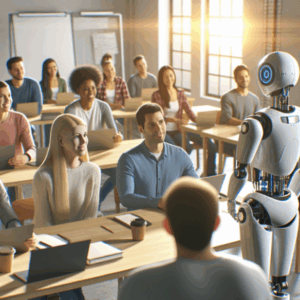
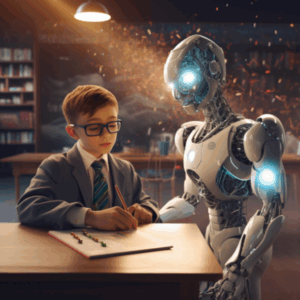
Brace yourself folks, Robots, Smart Robots powered by AI may, no, will be teaching our kids. Not only in the classroom but you will buy RoboAI to help your kids learn at home too

Challenge me, please… if you do not agree with any of this.


But in closing, I do have a warning.  In this high-tech digital age, we are all addicted to our machines and devices. Hard to teach our kids to put down that smart phone or stop with the social media jazz when we are so dependent on it too. Communications are best practiced one-on-one / person-to-person.  Connecting with people emotionally as well as intellectually. My concern going forward is the danger of a most essential part of everyone’s overall health: the personal development & growth of human relationships.  That may be where artificial intelligence has its limitations.

Ah, the Truth………Finding the Truth is Always a Challenge

Being open-minded means actively searching for reasons we might be wrong—not for reasons we must be right—and revising our views based on what we learn. Psychologist Adam Grant

I feel humans have three options in the search for the truth, open to all of us:
1.       Listen only to those we agree with in order to confirm our own beliefs

……makes us feel good but if we are wrong, truth has no chance.

2.       Listen to those we do not agree with in order to re-enforce our contrary beliefs

……..makes us angry, re-enforces our beliefs, truth be damned.

3.       Listen to both sides with an open mind to determine the truth as best we can

………still may not find the truth but the truth at least has a chance.

Open mind to me is key (quote above)………that means controlling our beliefs, not abandoning them, and respecting opposing sides, understanding what’s different, as long as we are not dealing with evil.  Satan is the only one we should not respect.  Liberals, progressives, traditionalists, conservatives, democrats, republicans, independents, etc. etc. etc. all have something to say and we can learn, grow and maybe even change when truth shows its face. One truth is people believe what they want to believe. The stronger that feeling, less chance minds will be changed and that truth will prevail. My opinion: any medium, any show, any publication that refused to air dissenting opinion should not be watched, that is if you want the truth.

About LearnersLive
LearnersLive.com is a platform dedicated to continuous learning and professional growth. Focused on leadership, marketing, and management, the site offers virtual courses, expert interviews, and curated industry resources. With new content added regularly, LearnersLive.com empowers individuals and organizations to embrace change through ongoing education and insight.

Challenging Journey to Inspirational Leadership

I’m sure you, like me, have read many books over the years about leadership.  Are leaders born or made?  Answer: YES to both! Just posted a virtual learning session on YouTube and LearnersLive.com is about:

  1. Good to Great by Jim Collins
  2. Extreme Ownership by former U.S. Navy SEALS Jock Willink & Leif Babin

Powerful leadership principles from the battlefield to business and to life.


We take you on a challenging journey from being a competent individual to an inspirational leader…..the key word is “challenging”. Competent Individual to Inspiration Leader 

Inspirational Leaders possess certain attributes that distinguish them from everyone else. They anticipate rather than react to change.  Some call that vision. They become essential facilitators of change within their altered environment. They can skillfully communicate the new and technically esoteric with a clarity that leads to understanding and advocacy. Those in their lead execute the plan because they want to.

In every environment, in every company, in every department, in every office, in every classroom, on every team, there are inequities.  Men and women come in all sizes, all levels of acumen, all degrees of competency, skill and talent……..Many times in any organization and often, not of your choosing, you get a diversity of high performers, good performers, weak performers, and those that do not contribute a dime to the performance of the team. When it comes to standards of performance, you have to decide how much are you willing to tolerate.  Inspirational leaders put together teams of exceptional talent and high standards of performance.  In the book Extreme Talent, the former Navy Seals say it bluntly: “There are no bad teams, only bad leaders.”  If your team fails, it’s on you the Leader.  Get your arms around that concept…..

Inspirational Leaders have certain skills and they are good at it, rather, they are expert at it.

  1. Set Goals… get buy-in by everybody!
  2. Opportunities – vision & execution
  3. Problem-Solving –
  • Internal: to prevent damage to the business
  • External: to solve customer pain points
  1. Decision-Making – do the right things

 About LearnersLive
LearnersLive.com is a platform dedicated to continuous learning and professional growth. Focused on leadership, marketing, and management, the site offers virtual courses, expert interviews, and curated industry resources. With new content added regularly, LearnersLive.com empowers individuals and organizations to embrace change through ongoing education and insight.

Learning to Get Better by Bill Attardi

Learners possess certain attributes that distinguish them from the learned. They anticipate rather than react to change.  Some call that vision. They become essential facilitators of change within their altered environment. They can skillfully communicate the new and technically esoteric with a clarity that leads to understanding and advocacy. Organizations that don’t value learning and the change that springs from learning will struggle to stay relevant in this fast-paced ever-changing marketplace.

As an Educator, my ambition here is to express my view that education, the learning process, is not a onetime event but rather, something you do all the time.  Sounds a lot like Vince Lombardi when he talked about doing things right, not once in a while but all the time, right?  Winning is everything…… remember that?

In every environment, in every company, in every department, in every office, in every classroom, on every team, there are inequities.  Men and women come in all sizes, all levels of acumen, all degrees of competency, skill and talent……..

Many times in any organization and often, not of your choosing, you get a diversity of high performers, good performers, weak performers, and those that do not contribute a dime to the performance of the team.  When it comes to standards of performance, you have to decide how much are you willing to tolerate.   In my undergraduate classes, especially when they are mostly seniors, and certainly in my graduate classes at Monmouth University, I congratulate them for the progress they have made so far in their collegiate work and no matter the future, as they receive that degree, each and every one of them has earned the right to be called a highly competent individual. There’s a but: that’s only the beginning, do you have the dedication to learning to get better…

You Write it, AI Fine-Tunes It! by Bill Attardi

No matter your job or position, your ability to communicate – whether in writing or speaking – at the highest level of your capability will determine your relationships and your success in those relationships. Early on in life, most of us struggled with communicating our thoughts but you always knew developing that skill is essential.  Business, like life, is a team sport and engaging and working with others is an everyday occurrence.  The competency to communicate effectively is a continuing learning process.  It’s a critical skill for success.  The more you do it, the more competent you become.

Help is on the way. Enter AI – Artificial Intelligence.  Yes, AI, the most powerful learning tool ever created.  It can make you smarter, if you understand how it makes you learn.  At Monmouth University, we integrate AI into our oral and written communication assignments to help students excel. Oral communications take the form of creating a slide presentation analyzing real-world case studies.  Terrific learning experience to help them strengthen both their critical thinking and public speaking skills. We ask them to use AI to refine their delivery and content. For writing, we emphasize a critical process: original thought first. Write as you would have before AI ever existed, then feed your original work into AI and prompt AI to be your personal Writing Tutor to fine-tune it. This approach ensures you learn something new with every draft, steadily improving your writing skills and boosting your confidence. Again, it will make you smarter.

Why AI?

AI isn’t just a tech tool; it’s a game-changer for learning. It replaces those outdated methods with instant, powerful resources, accessible every time you have a need.

  • The Library – Once, we pored over books or today e-books for knowledge. AI’s vast “Big Data” library contains everything ever written, accessible in seconds. Now it’s all in the AI Library…
  • The Encyclopedia – We learned general background info on any topic from a collection of books in alphabetical order, to make it easy to find stuff. How nice was that… Fuhgeddaboudit….. Forget flipping through volumes of information for hours. Just prompt AI, and it retrieves precise answers instantly.
  • News & Media – From newspapers to social media and everything in between, we’ve always brainstormed ideas and information to spark debate or insight of current events. AI aggregates, compares and evaluates that thinking, helping you form sharper, more accurate conclusions. That is if ideology does not get in the way.
  • The Teachers – Many Teachers from grade school thru higher education all focused on Reading, wRiting and aRithmetic, right? Coaches, Tutors, Trainers, Teachers…all to make us smarter. Well, AI may be replacing us. Educators pass on what they know to help the learning process of others. Now, AI offers unmatched expertise, analyzing your writing for clarity, grammar, and style, and suggesting improvements no human could match in speed and scale never seen before.  So where do we teachers fit in?  Probably another blog… any suggestions?

Addressing AI Misuse

Since we are talking about education, let me end this blog by talking about the elephant in the room – Plagiarism – that is what it is and it has always been a problem.  Sure, some students will misuse AI to bypass learning, to cheat, to plagiarize an assignment. Nothing new here…….

I spend no time policing when a student cheats. That’s a personal choice for me. It’s their choice if they want to learn or not.  If they want to use AI to do all their work and learn nothing, they will find a way and it’s a losing battle for teachers, and frankly, a waste of time.  Instead, the focus should be on inspiring students to see AI’s value as a lifetime learning tool. When used correctly, AI doesn’t just help you complete assignments—it makes you smarter. The choice is simple: embrace AI to grow, or miss out on its transformative potential, is the message. Not everyone will buy in, but those who do will thrive in a world where lifelong learning is non-negotiable.  I still have faith in those that cheat.  Some are just not ready to accept that learning is a never-ending process and that there are no short-cuts. When they figure it out, they will be fine.

 The Future Is Here

AI’s full impact on education—and life—is just beginning to unfold. But one thing is already clear: it can enhance everything we do. Start with your original ideas. Use AI to refine, elevate, and clarify. You write it, AI fine-tunes it! Practice this consistently, and you’ll do more than just communicate better. You’ll think better. You’ll learn faster. You’ll work smarter. And ultimately, you’ll succeed in ways you never thought possible. Word of caution: connecting with people emotionally as well as intellectually is important for our overall health. Buona Salute!


The Statue of Liberty was made with copper but due to oxidation, it turned green.

When the “Lady in the Harbor” first arrived in New York in 1886, she didn’t look like the mint-green icon we know today. In fact, for the first twenty years of her life, she stood as a towering, metallic beacon of reddish-gold. Designed by French sculptor Frédéric Auguste Bartholdi and engineered by Alexandre Gustave Eiffel, the statue was a gift from France to America. To build her, Bartholdi chose copper for three practical reasons:

  • Malleability:It could be hammered into elaborate, thin sheets.
  • Weight:Copper is lighter than stone or bronze, making it easier to ship 350 individual pieces across the Atlantic.
  • Durability:It was strong enough to survive a 27-day ocean voyage and the harsh winds of the harbor.

When she was unveiled on October 28, 1886, her skin—made of 300 copper sheets roughly the thickness of two pennies—shone with a bright, metallic brown luster. The transformation from “penny-colored” to “patina-green” wasn’t planned. Bartholdi actually expected the statue to age into a deeper, darker red. However, the unique environment of New York Harbor—a mix of salt air, moisture, and industrial pollution—triggered a process called oxidation.

The Timeline of Change:

  1. 1886–1900:The bright copper dulled into a dark, muddy brown.
  2. 1903:The first hints of a light green crust, or “patina,” began to appear.
  3. 1906:The color change was so controversial that Congress nearly stepped in. They appropriated $62,000 to paint the statue back to its original color, but the public protested, calling the idea “sacrilege.”
  4. 1910–1920:The statue was a patchy mix of brown and green until 1920, when the oxidation was complete, leaving her entirely teal.

While we now view the green color as iconic, it actually serves a vital structural purpose. The layer of verdigris (the green patina) acts as a protective shield. It seals the copper underneath, preventing the metal from further corrosion and weathering.  By the time the color fully changed, a new generation of immigrants had arrived in America seeing a green statue.