Learners Live

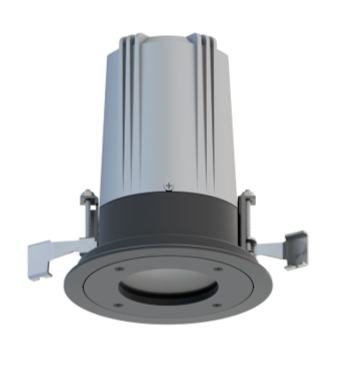
Amerlux Mini Cavaletto Family

The Mini Cavaletto LED is a compact, recessed adjustable wall wash luminaire for commercial and retail environments. The unique optical design allows for 2:1 fixture to wall spacing while providing uniform light on the vertical plane. The Mini Cavaletto LED is a compact, recessed adjustable wall wash luminaire for commercial and retail environments. The unique optical design allows for 2:1 fixture to wall spacing while providing uniform light on the vertical plane. The high-performance optical head with various wattage options can be flush with the ceiling line to provide general illumination or pulled down (up to a 45-degree tilt) for wall washing or menu board lighting. Spaced up to 8′ on center, the Mini Cavaletto LED produces an even gradient of light for any vertical surface. Mini Cavaletto Family – Amerlux – Commercial Interior Lighting Products

SATCO|NUVO’s Plus Series Commercial Downlights

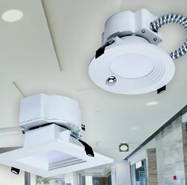
With and Without Emergency Backup | Square & Round SATCO|NUVO’s Plus Series LED Commercial Downlights deliver exceptional performance and versatility for today’s remodel or new construction commercial environments. Offered in 4, 6, 8 and 10-inch round or square configurations, these downlights feature field-selectable wattage and CCT settings, 90 CRI illumination, and dual dimming for optimal flexibility. The series includes both standard and pre-wired emergency battery backup models, with emergency versions equipped with a long-life lithium-ion battery, integrated test indicator button light, Self-Diagnostic functionality and a 90-minute runtime. Each fixture includes a white-painted aluminum regressed baffle and frosted lens for enhanced comfort and reduced glare. Field-installable trim accessories are also available in black, bronze, or silver. Features:

  • Standard & Pre-Wired SD Emergency Models
  • Integrated Test Button on Emergency Models
  • Dual Dimming
  • Round & Square Shapes in 4″, 6″, 8″, & 10″ Sizes
  • 90 CRI High Quality Light

Plus Series Commercial Downlights With and Without Emergency Backup

SN1918_Std_EM_Dual_Dim_Comm_DL_PI_11-4-25.pdf

That’s one small step for man, one giant leap for mankind – The last time human beings headed moonward was on the Apollo 17 flight that launched Dec. 7, 1972—before any of the Artemis II crew members were born. Today’s crew will not land on the moon—they won’t even orbit the moon. But they will whip around the lunar far side, on a shakedown mission test-flying the Orion spacecraft. This is essential preparatory work for achieving NASA’s bigger lunar goals. Next year there will be another test flight in low Earth orbit during the flight of Artemis III, followed by up to two moon landings by Artemis IV and V in 2028, and annual landings thereafter. Unlike the Apollo program, Artemis aims not just for the so-called flags-and-footprints model of short, one- to three-day stays on the moon, but for a long-term presence at a long-term moon base in the south lunar pole, where deposits of ice can provide drinkable water, breathable oxygen, and oxygen-hydrogen rocket fuel. Very much like the Apollo program, Artemis finds itself in a closely watched moon race, not with the old Soviet Union this time, but with China, which has announced its intention to have astronauts on the moon by 2030. The U.S. is not going it alone this time, however. While Apollo was an entirely American enterprise, Artemis flies under the flag of 60 countries, signatories to the Artemis Accords, an international pact whose members vow to support the peaceful exploration of space and contribute money, modules, and astronauts to the Artemis cause. Artemis II Has Launched. Here’s Everything You Need to Know