Lumileds LUXEON 7070 HE Delivers Extreme Performance for Outdoor Lighting Applications

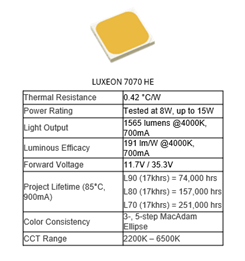 Lumileds’ newest LUXEON 7070 HE delivers more than 1500 lumens and over 190 lm/W, simplifying the development of outdoor lighting applications that require very high light output levels, such as high-mast, high-bay, and flood lights. LUXEON 7070 HE is tested and specified at 8W and delivers 2500 lumens at its rated power of 15W. LUXEON 7070 HE is available in both 12V and 36V packages and is hot color targeted for 85°C for color accuracy and consistency. At 700mA, 4000K LUXEON 7070 HE delivers typical 1565lm and 191 lm/W. https://lumileds.com/
 The WAC HOME smart lighting system allows users to control lighting with a tap or a voice command. They can adjust the color temperature or brightness of a single light, set up groups or manage an entire home’s lighting, inside and outdoors. The system is engineered with smart WAC- Mesh technology and the MyWAC app for enhanced control and connectivity to manage and monitor lighting from anywhere worldwide. Users can schedule luminaires according to dates/times, special events, and scenes within the comfort of their home. They can set custom CCT and intensity ranges or choose from a selection of presets for a personalized experience in every room.
 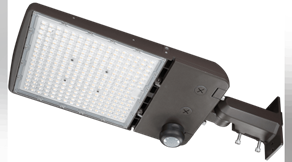 The SWOA Series LED Area Light is designed for versatility, durability and superior energy efficiency. It’s engineered to provide customizable lighting solutions for parking lots, pathways, building facades and other outdoor spaces. The fixture features field-switchable options, including easily adjust light distribution (Type III, IV, V); power output (14,500 to 48,000 lumens); and CCT (3000K-4000K-5000K) directly on-site. Each unit comes standard with an adjustable universal arm for mounting to square or round poles, as well as walls, ensuring seamless installation.
 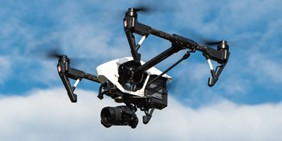 Packed with the latest sensing, machine-learning and computer processing technologies, the role of unmanned aerial vehicles (UAVs), also known as drones, is being redefined in next-generation emerging applications—finding increased use in markets seeking higher levels of safety and more efficient operations. The
  The naturaLED® 7X7 floodlight offers selectable wattages and color temperatures for versatile lighting solutions. With a flood beam distribution, it replaces up to 400-watt fixtures and includes a built-in photocell for efficiency. Its IP65 water-resistant rating ensures durability in outdoor conditions. Ideal for security, perimeters, entryways, facades, landscapes, and architectural lighting, it delivers bright and reliable illumination. The pre-installed 1/2” knuckle mount allows for easy installation and angle adjustment. This floodlight provides a flexible and energy-efficient solution for various residential and commercial applications. APPLICATIONS: Security, Architectural, Perimeter, Entryway, Pathway, Landscape
 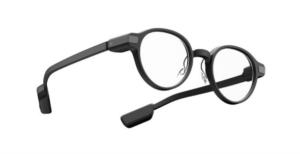 Dr. Qiu Xiaoling, CFO of JBD, has recently delivered a penetrating analysis of the MicroLED microdisplay and AR glasses ecosystem, illuminating how these once-independent frontiers are coalescing to redefine wearable AI. As AI evolves from merely being “smarter” toward truly “more attuned to you,” users increasingly expect an always-on digital assistant. AR glasses have emerged as the quintessential conduit for frictionless, context-aware interaction, and the ultra-compact MicroLED microdisplay has become the linchpin technology that turns the vision of lightweight, all-day wearable intelligence into daily reality. The fusion of AI and AR offers consumers a far more natural, convenient means of interaction and is catalyzing a revolution in smart wearable electronics. Meta’s CTO Andrew Bosworth has remarked, “The always‑on AI experience will allow smart glasses to replace the smartphone.”
 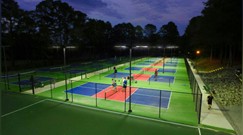 U. S. Architectural Lighting recently introduced Baseline – Pickleball & Tennis Court Lighting. Designed specifically for the court, Baseline uses a Type IV CL precision optic designed especially to meet IESNA / USA Pickleball / USTA Standard Performance Criteria for court photometrics. The luminaires distribute uniform light across the court surface without creating hot spots. To minimize glare, the light is directed at a low angle onto the court surface avoiding direct glare into the eyes of the players to prevent discomfort or distractions during play. The Baseline is available in five sizes in wattages from 85W to 550W, with up to four fixtures per pole, in parallel assembly arrangements, allowing a wide range of lumen packages.
  The NIGHT BREAKER® LED SMART ECE H11 is approved as a direct replacement for H11 halogen lamps. It delivers a modern bright white light with a color temperature of up to 6000 Kelvin. Its impressive light output ensures optimum visibility for the driver, while the glare seen by other road users is up to 50 percent less than the legally permissible maximum values. Compared to standard halogen lamps, these LED retrofit lamps consume up to 60 percent less energy and last up to six times longer thanks to LED technology and the specially developed vibration-resistant design. These characteristics make the NIGHT BREAKER® LED SMART ECE H11 a cost-effective and eco-friendly retrofit solution. For the first time there is no need for a compatibility list, no need to verify the headlamp approval number, no need to carry official approval documents, and no need to affix stickers.