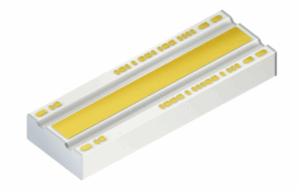
 Autonomous driving demands sensor technology that delivers precision, reliability, and long-range performance every second. LiDAR systems capture the environment in three dimensions, regardless of lighting conditions, and enable safe, real-time decision-making. With its new 5-junction edge-emitting laser, ams OSRAM introduces a key component that elevates these systems to a new level of performance. Compared to the previous 3-junction technology, the new laser offers significantly higher optical peak power while consuming less electrical current. LiDAR is no longer reserved for premium vehicles. Whether it’s robotaxis navigating urban environments, automated delivery vehicles, or highway-level driver assistance systems – the range of applications is expanding rapidly. The increased range and precision not only enhance object detection and classification – they also enable OEMs to increase the speed for autonomous driving. This opens up new possibilities for highway driving and advanced driver assistance systems, without compromising safety or system reliability. [News] New LiDAR Laser for the Next Generation of Vehicles – LEDinside




 The NIGHT BREAKER® LED SMART ECE H11 is approved as a direct replacement for H11 halogen lamps. It delivers a modern bright white light with a color temperature of up to 6000 Kelvin. Its impressive light output ensures optimum visibility for the driver, while the glare seen by other road users is up to 50 percent less than the legally permissible maximum values. Compared to standard halogen lamps, these LED retrofit lamps consume up to 60 percent less energy and last up to six times longer thanks to LED technology and the specially developed vibration-resistant design. These characteristics make the NIGHT BREAKER® LED SMART ECE H11 a cost-effective and eco-friendly retrofit solution. For the first time there is no need for a compatibility list, no need to verify the headlamp approval number, no need to carry official approval documents, and no need to affix stickers.
 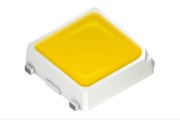 High efficacy, deep dimming performance, reliability, robustness, and flexibility are crucial criteria for indoor lighting and applications. ams OSRAM is now presenting new mid-power LEDs that embody all these essential features. The OSCONIQ® S 3030 offers luminous efficacy ratings of up to 235 lm/W at 4000K (CRI 80) and advanced features such as deep-dimming capability and precise color control. The LED reduces maintenance cycles making it perfect for office panels, troffers, and continuous linear lighting. When integrated into high-bay and low-bay fixtures, it provides consistent illumination in warehouses and manufacturing spaces. With high color rendering options (CRI 80 and CRI 90) and a wide CCT range from 2700K to 6500K, the OSCONIQ® S 3030 also optimizes architectural accents and retail displays. Its superior hydrogen sulfide resistance and robust thermal cycling performance ensures long-term stability, even in harsh operating conditions.