ams OSRAM’s Optical Force Sensing is Transforming Human-Machine Interaction

 A robotic hand that can sense touch. A sleek oven front panel with no visible controls. A smartwatch whose housing itself becomes an input surface. In all of these applications, the surface takes on a new role. It no longer serves merely as a housing but becomes part of the interaction itself. Whenever a robotic hand lifts a tool, it must detect how the forces are distributed across several of its fingers and how those forces change during the gripping process. Only by combining multiple contact points can a complete picture of the interaction be created. This is exactly where the ams OSRAM’s Analog Frontend AS7160 comes in. It controls up to eight optical frontends simultaneously and captures data from multiple sensor points in parallel. This enables robotic hands, for example, to analyze pressure information across multiple contact points to obtain a more accurate picture of the gripping process. Products are increasingly developing a digital sense of touch, enabling them to interact with their surroundings in more differentiated ways. Optical force sensing is transforming human-machine interaction | ams OSRAM
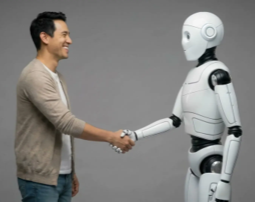 Humanoid robots are designed for direct interaction with humans in real‑world environments such as industrial production, logistics, healthcare and services. They rely on advanced sensing to detect people, objects and motion, enabling safe navigation and collaboration. High‑precision sensing and active illumination are key building blocks, providing real‑time environmental awareness and supporting safe physical interaction through technologies such as infrared sensing, 3D depth sensing and optical force sensing. Beyond functionality, light‑based visualization helps humanoid robots communicate status and intent in an intuitive, non‑verbal way, improving user understanding and supporting safe coexistence with humans. Lighting also plays a key role in human–robot interaction (HRI) by signaling status, intent and presence. Visible LEDs increase recognizability and trust, while projection systems provide intuitive, nonverbal communication.