Learners Live

EV Charger Rebate Trends for 2026 by BriteSwitch

2025 was a complicated year for the EV industry. EV sales fell sharply in Q4, and for those in the charging business, the headlines may have felt unsettling. But vehicle sales and the charging business are telling two very different stories. The US added 17% more charging ports, and utilization continues to climb. Electrek reported 141 million charging sessions in 2025, a 30% increase over the previous year. There are more EVs on the road than ever, and drivers are using public charging stations more frequently. Rebates still play a crucial role in building up the EV charging infrastructure in North America, and they’re as strong as ever. We break down the five biggest EV charger rebate trends shaping 2026:

BriteSwitch: Commercial Lighting Rebate Trends for 2026

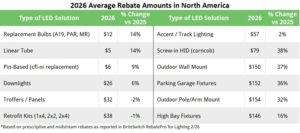
Electricity costs continue to climb, and commercial customers are once again taking a closer look at energy efficiency. In 2025 alone, average commercial electricity rates increased by roughly 7%, with some regions seeing increases as high as 29%. As operating costs rise, lighting rebates remain one of the most effective tools for improving project economics. So what does the commercial lighting rebate landscape actually look like in 2026, and what’s different this year? Most programs are still available this year, incentive amounts are up, and rebate structures are continuing to evolve. The following trends are shaping the commercial lighting rebate landscape in 2026.

Commercial Lighting Rebate Trends for 2026

BriteSwitch: Rebates Bloom as Horticulture Lighting Market Heats Up

Once limited to research labs and specialized grow rooms, horticulture lighting has become one of the fastest-growing segments in the lighting industry. As technology costs drop and efficiency improves, these systems are now used in greenhouses, vertical farms, floriculture, and even in facilities producing plant-based vaccines. The global market is expanding at roughly 12% per year and is projected to reach $22 billion by 2033, making it one of the brightest opportunities for both lighting manufacturers and rebate-driven projects. Like they did with traditional lighting, LEDs have revolutionized grow lights. With 20 to 45% less energy usage than conventional HID grow lights, they provide a huge opportunity to cut operating costs for growers. The reduced wattage also means less waste heat, which is hugely beneficial to indoor growing operations. In October 2019, the DesignLights Consortium (DLC) created a new standard and Qualified Products List (QPL) specifically for horticulture lighting. Over the years, the DLC has become the de facto standard utilities use to ensure customers install high-quality lighting when applying for incentives.  In 2025, the DLC released version 4.0 of its technical requirements.  55% of the US is covered by an active horticulture lighting rebate; 53% are calculated on a per-fixture basis.  BriteSwitch Can Help You Find and Capture the Rebates:

Rebates Bloom as Horticulture Lighting Market Heats Up

Fluorescent Tube Bans and the Effect on Lighting Rebates by BriteSwitch

Fluorescent tubes have long been a staple in the American lighting landscape, illuminating warehouses, offices, and public buildings across the nation for decades. However, recent legislative actions in several states signal a significant shift in lighting technologies. Twelvestates have passed legislation that will prohibit the sale of fluorescent tubes in the next few years. Most of these states also restrict integrated compact fluorescent lamps (CFL-i), pin-based CFL-ni lamps, and high-CRI linear fluorescent, although they may go into effect at different times.  In states with no legislation affecting the sale of fluorescent lamps, rebate availability will likely remain the same.  Fluorescent Tube Bans and the Effect on Lighting Rebates

BriteSwitch: LED-to-LED Upgrades and Rebates

Early adopters who first transitioned from fluorescent and HID to LED lighting a decade ago are discovering that it’s time to replace their early-generation fixtures. Traditionally, rebate programs haven’t supported LED-to-LED upgrades, but that’s starting to change. As LED technology has evolved, both light quality and efficacy have significantly improved. One effective way to measure these advancements is by examining the Design Lights Consortium’s (DLC)technical requirements. Increased efficacy basically means that new LED fixtures have to use fewer watts to get the same light output, providing an opportunity to realize additional energy savings.  RebatePro makes it easy to sort through all the commercial lighting rebates in the US and Canada. LED-to-LED Upgrades and Rebates

Commercial Lighting Rebate Trends for 2025 by BriteSwitch

Despite concerns of LEDs reaching market saturation and legislation restricting fluorescent lamp sales passed in 15 states, commercial lighting rebates are still as strong as ever. Programs may have evolved to adapt to current market conditions, but overall, these incentives remain widely available across North America and continue to be an important tool for improving the payback of lighting upgrades. Now that most programs have been updated for 2025, we take a look at the biggest trends, how rebate programs are evolving, and how to take advantage of them.

Commercial Lighting Rebate Trends for 2025

The Statue of Liberty was made with copper but due to oxidation, it turned green.

When the “Lady in the Harbor” first arrived in New York in 1886, she didn’t look like the mint-green icon we know today. In fact, for the first twenty years of her life, she stood as a towering, metallic beacon of reddish-gold. Designed by French sculptor Frédéric Auguste Bartholdi and engineered by Alexandre Gustave Eiffel, the statue was a gift from France to America. To build her, Bartholdi chose copper for three practical reasons:

  • Malleability:It could be hammered into elaborate, thin sheets.
  • Weight:Copper is lighter than stone or bronze, making it easier to ship 350 individual pieces across the Atlantic.
  • Durability:It was strong enough to survive a 27-day ocean voyage and the harsh winds of the harbor.

When she was unveiled on October 28, 1886, her skin—made of 300 copper sheets roughly the thickness of two pennies—shone with a bright, metallic brown luster. The transformation from “penny-colored” to “patina-green” wasn’t planned. Bartholdi actually expected the statue to age into a deeper, darker red. However, the unique environment of New York Harbor—a mix of salt air, moisture, and industrial pollution—triggered a process called oxidation.

The Timeline of Change:

  1. 1886–1900:The bright copper dulled into a dark, muddy brown.
  2. 1903:The first hints of a light green crust, or “patina,” began to appear.
  3. 1906:The color change was so controversial that Congress nearly stepped in. They appropriated $62,000 to paint the statue back to its original color, but the public protested, calling the idea “sacrilege.”
  4. 1910–1920:The statue was a patchy mix of brown and green until 1920, when the oxidation was complete, leaving her entirely teal.

While we now view the green color as iconic, it actually serves a vital structural purpose. The layer of verdigris (the green patina) acts as a protective shield. It seals the copper underneath, preventing the metal from further corrosion and weathering.  By the time the color fully changed, a new generation of immigrants had arrived in America seeing a green statue.