Learners Live

Wanted: Energy Savings: 2026 Lighting Rebate Outlook by Craig DiLouie

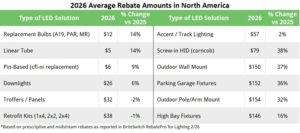
The commercial lighting rebate outlook for 2026 remains strong, with rebates available in about 75% of the United States and covering all popular LED and lighting control categories. About 7% of rebate programs started the year with bonuses already in place, according to rebate fulfillment firm BriteSwitch, Kingston, N.J., but many are taking a more strategic approach by aggressively promoting LED options most likely to produce high energy savings. Average rebates for LED products rose 17%, with larger increases—exceeding 30%—for products replacing HID luminaires. Meanwhile, the number of rebate programs incentivizing LED-to-LED upgrades increased by 22%. While still accounting for less than 10% of the total number of rebate programs, this is a trend worth watching. In 2026, 6% of programs shifted from basing incentives on a per-unit-installed basis to other metrics such as power or energy savings. This combines the flexibility and innovation of custom rebates with the relatively straightforward prescriptive rebates, promoting thoughtful design and product selection that maximize energy savings. Wanted: Energy Savings: 2026 lighting rebate outlook | Craig DiLouie – Electrical Contractor Magazine

2026 Commercial Lighting Rebate Outlook by Craig DiLouie

The commercial lighting rebate outlook is strong for 2026, with widely available rebates covering all popular categories of LED lighting and lighting controls, including networked lighting controls. Overall, 2026 marks a year of evolution for programs as they adapt to declining lighting energy savings due to LED market saturation. Average rebate amounts per LED product significantly increased, particularly for higher-energy-saving products. Some programs are shifting from incentivizing products to energy savings. More programs recognizing LED-to-LED upgrades were introduced. On the lighting controls side, average rebate dollars per installed solution generally increased in 2026. As AI infrastructure/data centers and meta projects continue to come online, rising demand for electric power is leading to cost increases. This article evaluates the 2026 commercial lighting rebate outlook based on data provided by BriteSwitch’s RebatePro for Lighting North America database, examines opportunities for LED lighting and lighting controls, and offers insights into how rebate programs are evolving as LED adoption increases. 2026 Commercial Lighting Rebate Outlook

BriteSwitch: Commercial Lighting Rebate Trends for 2026

Electricity costs continue to climb, and commercial customers are once again taking a closer look at energy efficiency. In 2025 alone, average commercial electricity rates increased by roughly 7%, with some regions seeing increases as high as 29%. As operating costs rise, lighting rebates remain one of the most effective tools for improving project economics. So what does the commercial lighting rebate landscape actually look like in 2026, and what’s different this year? Most programs are still available this year, incentive amounts are up, and rebate structures are continuing to evolve. The following trends are shaping the commercial lighting rebate landscape in 2026.

Commercial Lighting Rebate Trends for 2026

Energy-Efficient Lighting Can Still Provide Opportunities for Energy Savings, DNV Study Finds

The study was undertaken in partnership with 11 organizations across the U.S. and Canada The study identified six separate “next generation” commercial lighting opportunities that are most likely to produce significant program savings or are gaining traction in the market. It graded these opportunities according to the potential size of the market, potential to deliver meaningful program savings, and ease of delivery. Three opportunities—higher efficacy LEDs, advanced lighting controls, and redesign LED-to-LED retrofit—are considered mass market opportunities and have the ability to fit into established energy management programs or have the ability to scale. The other three opportunities—demand management, germicidal UV, and tunable lighting—are niche market opportunities that apply to specific conditions and customers, and, while have the ability to provide energy savings, are not suited to broad adoption.  Energy-efficient lighting can still provide opportunities for energy savings, DNV study finds

Remembering the Solemn Purpose of Memorial Day

Memorial Day is a federal holiday in the United States observed on the last Monday in May to honor and mourn U.S. military personnel who died while serving in the armed forces. The holiday traces its roots to the years immediately following the American Civil War (1861–1865), which caused massive casualties—roughly 620,000 soldiers dead, about 2% of the U.S. population at the time. Communities across the North and South began spontaneously decorating the graves of fallen soldiers with flowers, wreaths, and flags, a practice that gave rise to the original name: Decoration Day. On May 5, 1868, Major General John A. Logan, commander-in-chief of the Grand Army of the Republic (GAR)—a powerful Union veterans’ organization—issued General Order No. 11. This proclaimed May 30, 1868, as a nationwide “Decoration Day” to honor those who died in the Civil War. After World War I, the holiday expanded to honor all American service members who died in any war, not just the Civil War.  In 1968, Congress passed the Uniform Monday Holiday Act to create more three-day weekends for federal employees. This moved Memorial Day to the last Monday in May, effective in 1971, when it was also officially named “Memorial Day.” As one 1868 quote put it: “That Nation which respects and honors its dead, shall ever be respected and honored itself.”