Deep Dive: Fundamentals of Commercial Lighting Controls by Craig DiLouie

A good lighting design is incomplete without a good controls design. Lighting controls determine when the lights turn On, when they turn Off, how bright they are, which luminaires respond, the response to daylight or occupancy, and how occupants interact with the lighting in the space. Controls may be simple or highly sophisticated, but every control system can be defined by the same fundamentals: inputs, outputs, programming, communication, and sequence of operation. This content is written for those who already have a working knowledge of lighting and now need a foundation in lighting controls. Lighting controls may be as simple as a wall switch or as advanced as a networked system……… Lighting professionals focus on providing good lighting design that supports visibility, comfort, safety, appearance, and energy performance. Lighting controls determine how the lighting behaves. A lighting system without appropriate controls may provide the right amount of light, but not necessarily at the right time, for the right task, or in the way occupants prefer. Controls facilitate the lighting system response to people, schedules, daylight, energy goals, code requirements, and changes within the space. . Deep Dive: Fundamentals of Commercial Lighting Controls
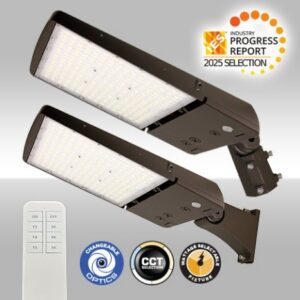 The MaxLite AE Switch Area Light offers tremendous selectability and controls capabilities. Besides CCT and Wattage choices, it expands its versatility to include changing distributions between Types III, IV and V. Now available with the ability to change CCT and Distribution with a remote control from the ground! It covers wattages ranging from 75W-300W in either 120-277V or 277-480V using two low EPA housings. It also offers a variety of mounting options along with visor accessories. All of this is available with robust surge protection and Maxlite’s proven quality bringing you great value in a competitive Value Series package.
  Lutron Electronics has released its Luxury Residential 2026 Trend Report: Living with Light, providing an in-depth look at emerging trends in residential lighting, automated shades, and controls. Informed by custom surveys from The Harris Poll driven by insights from high-net-worth homeowners and residential designers and architects, as well as Lutron sales and product data, the report highlights how lighting, shading, and controls are now central to both the aesthetic and emotional experience of a home. The report strongly signals that homes are increasingly prioritizing mood, wellness, and personalization. Motorized shades and app-controlled lighting are shifting from luxury upgrades to expected design essentials, while layered, tunable light is foundational to creating spaces that feel human, flexible, and attuned to the rhythms of daily life. Key findings:
 In keeping with its alliance with NEMA and the NEMA Academy, the Lighting Controls Association is now the Lighting Controls Academy, a NEMA coalition. The LCA remains the leader in lighting controls education. Under the “Learn” tab, you can click the “Video Courses” button for a roster of free video courses that will be dramatically expanded over the next year. Under the “NEMA Academy” tab, you can access our Education Express courses that are registered for education credit. The new platform includes an enhanced website, comprehensive learning experience, and access to a broad and growing curriculum covering lighting controls in addition to other topics and categories such as lighting.