


Learners Live

Construction Jobs Increase in 38 States Year-Over-Year

Construction employment rose in 38 states from January 2025 to January 2026, while 40 states and the District of Columbia added jobs between December and January, according to an analysis of new federal data released by the Associated General Contractors of America. Association officials called on policymakers in Washington to provide adequate support for training to enable workers to acquire in-demand skills and to allow qualified workers into the U.S when needed workers are not available. View January 2026 state employment data and 1-month12-month rankings.  Association officials noted that the industry has a critical need for electricians and other workers with the skills to construct data centers and power projects. They urged the federal government to direct more funding to career and technical education and workforce training and to offer a pathway to employ needed workers from other countries.   Construction Jobs Increase in 38 States Year-Over-Year – tEDmag
ADP: Private Sector Employment, Pay Increased in March

Private sector employment increased by 62,000 jobs in March and pay was up 4.5 percent year-over-year according to the March ADP National Employment Report® produced by ADP Research in collaboration with the Stanford Digital Economy Lab (“Stanford Lab”). For additional information about the ADP National Employment Report, including historical files, employment and pay data, methodology, and a calendar of release dates, please visit https://adpemploymentreport.com/ADP: Private Sector Employment, Pay Increased in March

ABC: Construction Employment Rebounds by 26,000 in March

The construction industry added 26,000 jobs in March, according to an Associated Builders and Contractors analysis of data released today by the U.S. Bureau of Labor Statistics. On a year-over-year basis, industry employment has grown by 57,000 jobs, an increase of 0.7%. Nonresidential construction employment increased by 12,200 positions, with gains in all three subcategories. Nonresidential building added the most jobs, increasing by 4,500 positions. Nonresidential specialty trade and heavy and civil engineering added 3,900 and 3,800 jobs, respectively, in March. The construction unemployment rate was 6.7% in March. Unemployment across all industries dropped to 4.3%, but is still 0.1 percentage points higher than one year ago.  ABC: Construction Employment Rebounds by 26,000 in March – tEDmag

Walmart CEO Issues Wake-Up Call on AI

Walmart executives aren’t sugar coating the message: Artificial intelligence will wipe out some jobs and reshape the company’s workforce.  For now, Walmart executives say the transformation means the size of its global workforce will stay roughly flat even as its revenue climbs. It plans to maintain its headcount of around 2.1million global workers over the next three years, but the mix of those jobs will change significantly, said Donna Morris, Walmart’s chief people officer. What the composition will look like remains murky.  Though there is plenty of anxiety among workers and leaders, many executives say the U.S. labor market remains healthy and they don’t anticipate widespread unemployment because of AI.  89qCx6UzCDStQHAyWTf5-WSJNewsPaper-9-29-2025.pdf

ABC: Construction Adds 15K Jobs in June

The construction industry added 15,000 jobs on net in June, according to an Associated Builders and Contractors analysis of data released by the U.S. Bureau of Labor Statistics. On a year-over-year basis, industry employment has increased by 121,000 jobs, or 1.5%. The construction unemployment rate fell to 3.4% last month. Unemployment across all industries declined from 4.2% in May to 4.1% in June.  June’s employment report, coupled with recent inflation data, indicate that the U.S. economy continues to demonstrate solid momentum, stable unemployment and declining inflation. Construction added jobs for a second consecutive month.  ABC: Construction Adds 15K Jobs in June – tEDmag

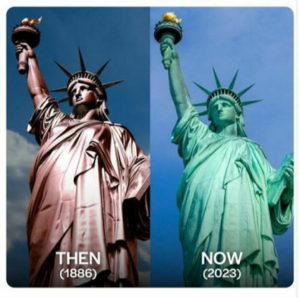
The Statue of Liberty was made with copper but due to oxidation, it turned green.

When the “Lady in the Harbor” first arrived in New York in 1886, she didn’t look like the mint-green icon we know today. In fact, for the first twenty years of her life, she stood as a towering, metallic beacon of reddish-gold. Designed by French sculptor Frédéric Auguste Bartholdi and engineered by Alexandre Gustave Eiffel, the statue was a gift from France to America. To build her, Bartholdi chose copper for three practical reasons:

  • Malleability:It could be hammered into elaborate, thin sheets.
  • Weight:Copper is lighter than stone or bronze, making it easier to ship 350 individual pieces across the Atlantic.
  • Durability:It was strong enough to survive a 27-day ocean voyage and the harsh winds of the harbor.

When she was unveiled on October 28, 1886, her skin—made of 300 copper sheets roughly the thickness of two pennies—shone with a bright, metallic brown luster. The transformation from “penny-colored” to “patina-green” wasn’t planned. Bartholdi actually expected the statue to age into a deeper, darker red. However, the unique environment of New York Harbor—a mix of salt air, moisture, and industrial pollution—triggered a process called oxidation.

The Timeline of Change:

  1. 1886–1900:The bright copper dulled into a dark, muddy brown.
  2. 1903:The first hints of a light green crust, or “patina,” began to appear.
  3. 1906:The color change was so controversial that Congress nearly stepped in. They appropriated $62,000 to paint the statue back to its original color, but the public protested, calling the idea “sacrilege.”
  4. 1910–1920:The statue was a patchy mix of brown and green until 1920, when the oxidation was complete, leaving her entirely teal.

While we now view the green color as iconic, it actually serves a vital structural purpose. The layer of verdigris (the green patina) acts as a protective shield. It seals the copper underneath, preventing the metal from further corrosion and weathering.  By the time the color fully changed, a new generation of immigrants had arrived in America seeing a green statue.