

Learners Live

Duke Energy Lays Out New Energy Plan for the Carolinas

South Carolina is one of the fastest-growing states in the nation, attracting new residents, major employers, and billions of dollars in economic investment. Meeting the state’s energy needs requires a reliable energy system that can support thriving communities while keeping costs as low as possible for customers. The latest plan for South Carolina advances new generation, new energy storage and renewables opportunities, evaluates future nuclear generation options, maximizes energy efficiency and maintains flexibility to adapt as customer needs, technology and market conditions evolve. To explore more details of the Carolinas Resource Plan, visit duke-energy.com/CarolinasResourcePlanDuke Energy Lays Out New Energy Plan for the Carolinas

Your First LED Retrofit Is Aging: How Facility Managers Can Prepare for the Next Replacement Cycle by Paul Chamberlain

What happens when your original LED retrofit reaches the end of its life? Your biggest challenge may not be finding the most energy-efficient system—it could be costs, complexity of replacement and serviceability. Key Highlights

  • Understanding the replaceability and support status of existing LED components is essential to avoid unexpected costs during upgrades.
  • Labor, downtime, and waste management often constitute significant project costs, requiring early evaluation and planning.
  • Operational disruptions can be minimized through strategic scheduling, phased implementation, and coordination with building occupants.
  • Sustainability now encompasses waste reduction, material management, and long-term asset stewardship, not just energy efficiency.
  • Modular lighting systems offer future maintainability, allowing components to be renewed without full fixture replacement, reducing labor and waste.

Your First LED Retrofit Is Aging: How Facility Managers Can Prepare for the Next Replacement Cycle | Buildings

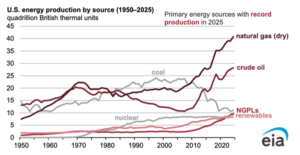
The US Sets Record Energy Production in 2025

Total energy production in the United States increased to a new record of 107 quadrillion British thermal units (quads) in 2025, a 3.4% increase from the previous record set in 2024, according to new data in the U.S. Energy Information Administration’s (EIA) latest Monthly Energy Review. Total production was driven by record-high production in natural gas, crude oil, natural gas plant liquids (NGPLs), and renewables. This was the fourth consecutive year in which the United States set a record for total energy production. Coal accounted for 10% of domestic energy production in 2025. The US Sets Record Energy Production in 2025 – tEDmag

U.S. Reaches Trade Deal with Europe

The European Union and the United States agreed on Sunday to a broad-brush trade deal that sets a 15 percent tariff on most goods, including cars. In addition:

  • The European Union had agreed to purchase $750 billion of American energy
  • EU to increase its investment in the United States by more than $600 billion above current levels.
  • EU would buy military equipment
  • No tariffs would be imposed on some goods.

The agreement will “rebalance, but enable trade on both sides,” Ursula von der Leyen, the president of the European Commission said. The European Union last year accounted for nearly $610 billion of the $3.3 trillion in goods imported by the United States.

U.S. Reaches Trade Deal With Europe – The New York Times

U.S. and Israel Pledge to Work Together to Unleash AI Innovation

The Memorandum of Understanding (MOU)  highlights the transformative potential of AI to improve the security and resilience of America and Israel’s energy systems. The two countries further announced their intent to pursue cooperation in areas including analyzing the impact of rising energy demand due to data centers, opportunities for grid optimization, enhanced AI-enabled cybersecurity tools, sharing best practices on the use of AI in energy infrastructure, and the launching of bilateral pilot projects. U.S. and Israel Pledge to Work Together to Unleash AI Innovation – electrifiED

Energy Secretary Announces Updated NEPA Procedures

The U.S. Department of Energy (DOE) announced new updates to the Department’s National Environmental Policy Act (NEPA) procedures. As part of a government-wide effort to restore common sense to permitting, DOE published an interim final rule rescinding all NEPA regulations and published new NEPA guidance procedures for the Department of Energy. The Council on Environmental Quality coordinated a historic, interagency effort to simplify NEPA compliance, lower construction costs, eliminate years-long delays, and ensure environmental reviews can no longer be used to stall American energy production and infrastructure development. This action fulfils President Trump’s Executive Order 14154, Unleashing American Energy, and implements reforms enacted by Congress under the 2023 BUILDER Act.  These reforms will enable the deployment of more efficient technologies and the better environmental outcomes that they provide.  Energy Secretary Announces Updated NEPA Procedures – electrifiED

US, Saudi Arabia Agree on Energy & Critical Mineral Deals

The MOU also highlights the intent to collaborate in various fields including petroleum refining and refined products trading, electricity generation technologies and energy storage systems, and artificial intelligence projects to accelerate deployment of energy-driven innovations. The two sides also outlined areas for cooperation on civil nuclear energy, including safety, security, and nonproliferation programs; vocational training and workforce development; U.S. Generation III+ advanced large reactor technologies and small modular reactors; uranium exploration, mining, and milling; and safe and secure nuclear waste disposal.  The signings coincided with President Trump’s announcement that he secured a $600 billion investment commitment from Saudi Arabia.  US, Saudi Arabia Agree on Energy & Critical Mineral Deals – electrifiED

Energy Department Proposes to Cut 47 Rules in ‘Largest Deregulatory Effort in History’ by Rachel Frazin

 The Energy Department plans to ax a long list of efficiency regulations, including those pertaining to stoves, ovens, showerheads, clothes washers, dishwashers and microwaves. The rules also apply to a smattering of other policies ranging for guidelines under which the department buys oil for the Strategic Petroleum Reserve to nondiscrimination requirements for grant recipients. Energy Department proposes to cut 47 rules in ‘largest deregulatory effort in history’

Schneider Electric to Invest Over $700 Million in the U.S.

 The company’s investments support the country’s focus on bolstering the nation’s energy infrastructure to power AI growth, boost domestic manufacturing, and strengthen energy security. The investment is the largest planned single capital expenditure commitment by Schneider Electric in its 135+ year history. It includes manufacturing expansions and job growth, reflecting the company’s robust customer demand for solutions to increase energy efficiency, scale industrial automation, and deliver a more reliable grid. Coupled with previous investments in 2023 and 2024 to strengthen its North American supply chain, Schneider Electric’s latest U.S. planned investment will surpass $1 billion so far this decade. This new planned investment is expected to create over 1,000 new jobs and help Schneider Electric continue to play a leading role in shaping a more innovative, affordable, and energy-efficient future in the U.S. Schneider Electric to Invest Over $700 Million in the U.S. – tEDmag 

GE Vernova Outlines $600M US Expansion

GE Vernova Inc. outlined a capital investment program for U.S. manufacturing and development operations totaling close to $600 million through 2027. It projected the investments would address issues involving energy affordability, national security, and manufacturing growth, and would prompt the creation of more than 1,500 new jobs. GE Vernova, which is the former General Electric portfolio of businesses that manufacture industrial and alternative energy systems, pegged the new U.S. investments as part of its broader, $9-billion global capital investment and research program. Among the planned U.S. investments:

  • Greenville, SC ($160 million)
  • Niskayuna, NY ($100 million)
  • Parsippany, NJ, Bangor, ME, Schenectady, NY ($50 million each)
  • Clearwater, FL, Charleroi, PA ($20 million each)
  • Also Pensacola, Grand Forks, Amarillo, Wilmington, Pittsburgh

Energy Giant Outlines $600M US Expansion | GE Vernova | American Machinist

It’s Back to School – How Some of Our Most Acknowledged Universities Got Their Name – Who were the true visionaries who would donate half of their estate to sculpting the minds of the future. These stories are monuments to history and culture. Let’s take a stroll through academia’s memory lane and uncover the origins of these storied university names!

  1. Ah, Harvard! The Ivy League giant was once a small college in the Massachusetts Bay Colony settlement called New Towne. But where did “Harvard” come from? Enter John Harvard, a clergyman who, in 1638, decided to bequeath half his estate and his library (a whopping 400 books!) to the fledgling college. Grateful for this generous gift, they promptly named the institution after him.
  2. A gem of New Haven, Connecticut, Yale is another Ivy League powerhouse known for its prestigious law and drama schools. It owes its name to Elihu Yale, a wealthy merchant who, in 1718, donated a modest shipment of goods (including portraits, books, and textiles) to a struggling collegiate school. Those goods were auctioned off, raising a much-needed £562 –a small fortune at the time.
  3. Dartmouth is renowned for its beautiful rural setting, nestled in the picturesque town of Hanover, New Hampshire. It was named after the Earl of Dartmouth, William Legge, a British nobleman who supported the college’s founding –despite never actually setting foot in America!
  4. Brown, this Rhode Island Ivy University, known for its open curriculum and emphasis on student choice, was founded with a mouthful of a name – the College in the English Colony of Rhode Island and Providence Plantations. It was renamed in 1704 for Nicholas Brown, Jr., a prominent merchant whose family donated generously to the school.
  5. Perched atop a hill overlooking Ithaca, New York, Cornell is celebrated for its diverse academic programs and its stunning natural surroundings. Founded by Ezra Cornell and Andrew Dickson White, this university was unique for its commitment to practical education, allowing students the freedom to choose their own course of study. It was a revolutionary notion at the time, which would guide a curricular reform across the country.
  6. Located in the heart of Silicon Valley, Stanford is renowned for its entrepreneurial spirit and its close ties to the tech industry. But this California powerhouse has a touching origin story. Leland Stanford, Jr., the founder’s son, tragically died young from typhoid fever. His father Leland Sr., railroad magnate and former state governor, and his mother Jane, founded the university in his memory, ensuring his legacy lived on through the pursuit of knowledge.
  7. This North Carolina research giant, known for its strong medical and law schools, underwent a bit of a name change in its history. Originally called Trinity College, it was renamed Duke University in 1924 after James Buchanan Duke, a tobacco and electric power industrialist who founded the American Tobacco Company. He established The Duke Endowment, to which he donated throughout his life and left half his estate after his death.
  8. Nestled in Nashville, Tennessee, Vanderbilt is a renowned research university with a vibrant campus life. It owes its name to “The Commodore,” Cornelius Vanderbilt, a shipping and railroad magnate, who provided the initial gift to establish the university.
  9. Texas businessman William Marsh Rice provided the initial funding for this Houston university, but did not live to see its opening. He was murdered by his valet as he slept, in a plot to forge the man’s will. Despite the unfortunate circumstances, Rice University flourished through the years, becoming an institution known for its strong engineering and science programs.
  10. Who was Harvard named after? Origin of university names