


Learners Live

Microsoft, Google among 24 firms joining US AI ‘Genesis Mission’ by Courtney Subramanian

Two dozen top artificial intelligence companies have signed on to join the federal government’s “Genesis Mission,” an effort by the Trump administration to boost the use of the emerging technology for scientific discovery and energy projects. OpenAI, Microsoft Corp., Nvidia Corp., Amazon Web Services and Alphabet Inc.’s Google were among the firms that have either already signed memorandums of understanding with the government, have existing projects with the Energy Department or national laboratories, or have expressed interest in joining the effort, according to a White House statement. The mission will harness the computing resources of the Energy Department’s national labs to tap federal datasets and enable more experiments utilizing AI, Michael Kratsios said at the time. He predicted the effort would help shorten the timeline for scientific discoveries. Microsoft, Google among 24 firms joining US AI ‘Genesis Mission’
DOE Advances Investments in AI for Science

The U.S. Department of Energy (DOE)has announced over $320 million in investments to rapidly advance the Genesis Mission’s artificial intelligence (AI) capabilities. These awards are in accordance with President Trump’s Working Families Tax Cut and other DOE appropriations to advance “AI for science” initiatives at the DOE. The awards will begin building the integrated American Science and Security Platform, a discovery engine designed to double the productivity and impact of American science and engineering investments within a decade. To view the full list of projects and awards, please click here. DOE Advances Investments in AI for Science – electrifiED


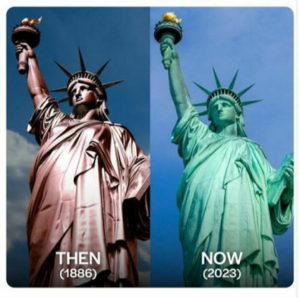
The Statue of Liberty was made with copper but due to oxidation, it turned green.

When the “Lady in the Harbor” first arrived in New York in 1886, she didn’t look like the mint-green icon we know today. In fact, for the first twenty years of her life, she stood as a towering, metallic beacon of reddish-gold. Designed by French sculptor Frédéric Auguste Bartholdi and engineered by Alexandre Gustave Eiffel, the statue was a gift from France to America. To build her, Bartholdi chose copper for three practical reasons:

  • Malleability:It could be hammered into elaborate, thin sheets.
  • Weight:Copper is lighter than stone or bronze, making it easier to ship 350 individual pieces across the Atlantic.
  • Durability:It was strong enough to survive a 27-day ocean voyage and the harsh winds of the harbor.

When she was unveiled on October 28, 1886, her skin—made of 300 copper sheets roughly the thickness of two pennies—shone with a bright, metallic brown luster. The transformation from “penny-colored” to “patina-green” wasn’t planned. Bartholdi actually expected the statue to age into a deeper, darker red. However, the unique environment of New York Harbor—a mix of salt air, moisture, and industrial pollution—triggered a process called oxidation.

The Timeline of Change:

  1. 1886–1900:The bright copper dulled into a dark, muddy brown.
  2. 1903:The first hints of a light green crust, or “patina,” began to appear.
  3. 1906:The color change was so controversial that Congress nearly stepped in. They appropriated $62,000 to paint the statue back to its original color, but the public protested, calling the idea “sacrilege.”
  4. 1910–1920:The statue was a patchy mix of brown and green until 1920, when the oxidation was complete, leaving her entirely teal.

While we now view the green color as iconic, it actually serves a vital structural purpose. The layer of verdigris (the green patina) acts as a protective shield. It seals the copper underneath, preventing the metal from further corrosion and weathering.  By the time the color fully changed, a new generation of immigrants had arrived in America seeing a green statue.