


Learners Live

Google to Fund NECA Training Program

Google is announcing a new paper and support for an effort to train 100,000 electrical workers and 30,000 new apprentices in the United States. This is Google’s news release: AI presents the United States with a generational opportunity for extraordinary innovation and growth. The deployment of AI will grow the American economy, create jobs, accelerate scientific advances and more. Fully realizing these opportunities requires an effort to rapidly increase the capacity of the nation’s existing, sometimes antiquated energy system. This in turn requires accelerating innovation and investment in advanced energy technologies; optimizing use of the existing grid and unlocking construction of new transmission infrastructure; and developing the labor force needed to build new energy infrastructure. Through shared public and private efforts to introduce and support training programs like this one, the U.S. can develop a model for training the next generation workforce. Google to Fund NECA Training Program – electrifiED
The Push to Triple Global Nuclear Energy by 2050

In recent years, the world has faced unprecedented growth in energy demand caused by digitalization, the development of artificial intelligence, electric vehicles, and other energy-consuming technologies. In an attempt to handle this challenge, Amazon, Meta, and Google — top stock gainers during previous years — as well as 14 leading banks and financial institutions, energy suppliers, and representatives of heavy industry, have joined forces to achieve the ambitious goal of tripling global nuclear power capacity by 2050. The World Nuclear Association initiated this program — for the first time, companies not directly involved in nuclear energy have publicly supported scaling nuclear power plants to meet their needs.  Powering the Future: The Push to Triple Global Nuclear Energy by 2050 – Programming Insider

Google’s Gemini Deep Research Is Now Available to Everyone by Igor Bonifacic

After being one of the first companies to roll out a Deep Research feature at the end of last year, Google is now making that same tool available to everyone. Starting today, Gemini users can try Deep Research for free in more than 45 languages — no Gemini Advanced subscription necessary. For the uninitiated, Deep Research allows you to ask Gemini to create comprehensive but easy-to-read reports on complex topics. Compared to say Google’s new AI Mode, Deep Research works slower than your typical chatbot, and that’s by design. Gemini will first create a research plan before it begins searching the web for information that may be relevant to your prompt. When Google first announced Deep Research, it was powered by the company’s powerful but expensive Gemini 1.5 Pro model. With today’s expansion, Google has upgraded Deep Research to run on its new Gemini 2.0 Flash Thinking Experimental model.  Google’s Gemini Deep Research is now available to everyone

Google Announces Gemini 2.5, its Next-Gen AI model

Google announced Gemini 2.5 on Tuesday, its next-generation family of artificial intelligence large language models that can “think.” “Gemini 2.5 models are thinking models, capable of reasoning through their thoughts before responding, resulting in enhanced performance and improved accuracy,” Google said in a blog post. “In the field of AI, a system’s capacity for ‘reasoning’ refers to more than just classification and prediction. It refers to its ability to analyze information, draw logical conclusions, incorporate context and nuance, and make informed decisions.” Google announces Gemini 2.5, its next-gen AI model

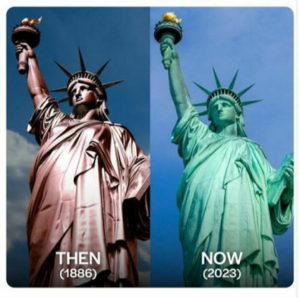
The Statue of Liberty was made with copper but due to oxidation, it turned green.

When the “Lady in the Harbor” first arrived in New York in 1886, she didn’t look like the mint-green icon we know today. In fact, for the first twenty years of her life, she stood as a towering, metallic beacon of reddish-gold. Designed by French sculptor Frédéric Auguste Bartholdi and engineered by Alexandre Gustave Eiffel, the statue was a gift from France to America. To build her, Bartholdi chose copper for three practical reasons:

  • Malleability:It could be hammered into elaborate, thin sheets.
  • Weight:Copper is lighter than stone or bronze, making it easier to ship 350 individual pieces across the Atlantic.
  • Durability:It was strong enough to survive a 27-day ocean voyage and the harsh winds of the harbor.

When she was unveiled on October 28, 1886, her skin—made of 300 copper sheets roughly the thickness of two pennies—shone with a bright, metallic brown luster. The transformation from “penny-colored” to “patina-green” wasn’t planned. Bartholdi actually expected the statue to age into a deeper, darker red. However, the unique environment of New York Harbor—a mix of salt air, moisture, and industrial pollution—triggered a process called oxidation.

The Timeline of Change:

  1. 1886–1900:The bright copper dulled into a dark, muddy brown.
  2. 1903:The first hints of a light green crust, or “patina,” began to appear.
  3. 1906:The color change was so controversial that Congress nearly stepped in. They appropriated $62,000 to paint the statue back to its original color, but the public protested, calling the idea “sacrilege.”
  4. 1910–1920:The statue was a patchy mix of brown and green until 1920, when the oxidation was complete, leaving her entirely teal.

While we now view the green color as iconic, it actually serves a vital structural purpose. The layer of verdigris (the green patina) acts as a protective shield. It seals the copper underneath, preventing the metal from further corrosion and weathering.  By the time the color fully changed, a new generation of immigrants had arrived in America seeing a green statue.