


Learners Live

Elon Musk Combined SpaceX and xAI

In the rare mega-merger of companies run by the same guy, Musk has brought together his rocket company, which has been planning an IPO, and his AI company, which is best known for Grok, the off-color chatbot that’s good at generating NSFW images. Sources told Bloomberg that the deal, which merges two of the world’s largest private companies, values the combined company at $1.25 trillion. Musk said the tie-up would help him put data centers in space, funding bases on the moon and a colony on Mars. He also said the combination would provide scale “to make a sentient sun to understand the Universe and extend the light of consciousness to the stars!” Morning Brew
Announcing Grok 3 and Grok 3 Mini on Azure AI Foundry

Microsoft and xAI are thrilled to unveil the availability of Grok 3 and Grok 3 Mini into the Azure AI Foundry Models, marking a significant milestone in AI accessibility and innovation. This collaboration combines xAI’s cutting-edge models with Azure’s enterprise-ready infrastructure, giving developers access to Grok 3’s advanced capabilities in a secure, scalable environment.  Grok models enable a range of enterprise scenarios with advanced capabilities in reasoning, coding, and visual processing. Announcing Grok 3 and Grok 3 Mini on Azure AI Foundry | Azure AI Foundry Blog

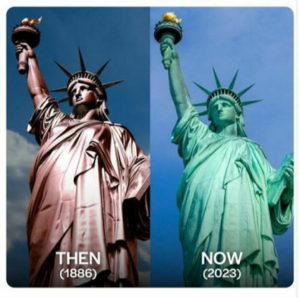
The Statue of Liberty was made with copper but due to oxidation, it turned green.

When the “Lady in the Harbor” first arrived in New York in 1886, she didn’t look like the mint-green icon we know today. In fact, for the first twenty years of her life, she stood as a towering, metallic beacon of reddish-gold. Designed by French sculptor Frédéric Auguste Bartholdi and engineered by Alexandre Gustave Eiffel, the statue was a gift from France to America. To build her, Bartholdi chose copper for three practical reasons:

  • Malleability:It could be hammered into elaborate, thin sheets.
  • Weight:Copper is lighter than stone or bronze, making it easier to ship 350 individual pieces across the Atlantic.
  • Durability:It was strong enough to survive a 27-day ocean voyage and the harsh winds of the harbor.

When she was unveiled on October 28, 1886, her skin—made of 300 copper sheets roughly the thickness of two pennies—shone with a bright, metallic brown luster. The transformation from “penny-colored” to “patina-green” wasn’t planned. Bartholdi actually expected the statue to age into a deeper, darker red. However, the unique environment of New York Harbor—a mix of salt air, moisture, and industrial pollution—triggered a process called oxidation.

The Timeline of Change:

  1. 1886–1900:The bright copper dulled into a dark, muddy brown.
  2. 1903:The first hints of a light green crust, or “patina,” began to appear.
  3. 1906:The color change was so controversial that Congress nearly stepped in. They appropriated $62,000 to paint the statue back to its original color, but the public protested, calling the idea “sacrilege.”
  4. 1910–1920:The statue was a patchy mix of brown and green until 1920, when the oxidation was complete, leaving her entirely teal.

While we now view the green color as iconic, it actually serves a vital structural purpose. The layer of verdigris (the green patina) acts as a protective shield. It seals the copper underneath, preventing the metal from further corrosion and weathering.  By the time the color fully changed, a new generation of immigrants had arrived in America seeing a green statue.