Learners Live

Engineer Speed and Governance for AI-Era Delivery

AI increases developer throughput, but without engineered platforms it amplifies risk. This Harvard Business Review Analytic Services whitepaper sponsored by Amazon Web Services (AWS) shows how leading companies combine faster CI/CD, predictive observability, AI-assisted testing, and supply-chain governance to reduce defects, cut lead time, and lower incident noise. Learn concrete practices and the KPIs that show ROI so your team can scale AI responsibly on AWS. .

Key takeaways of learning:

  • Strategies to implement the four pillars of modern software development.
  • Paths to successful adoption of modern software practices.
  • Ways to balance innovation with security and governance.
  • Best practices for integrating AI into development processes.

Embracing modern software development practices in the AI era
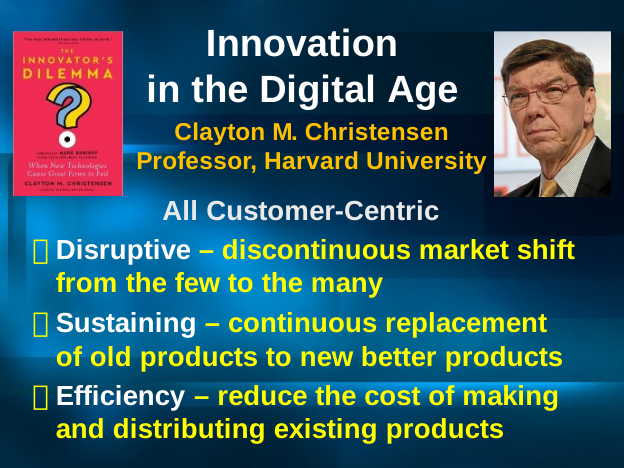
Innovation in the Digital Age

Innovation in the Digital Age.mp4 

Sponsored by naturaLED LED Lighting Solutions

 New product development is essential to survival in this dynamic global economy.  This e-learning session ups the ante to INNOVATION.  We have never seen change at this level of velocity and with the emergence of AI, it will speed up.  Clayton Christensen when he was at Harvard University detailed three (3) essential forms of innovation in his book: The Innovator’s Dilemma.  Worth reading……….my goal with this virtual learning session is to cover his essential points in order to encourage you to research this subject in more detail. Jack Welch said it best: If the rate of change outside is greater than the rate of change inside, the end is near.

The Statue of Liberty was made with copper but due to oxidation, it turned green.

When the “Lady in the Harbor” first arrived in New York in 1886, she didn’t look like the mint-green icon we know today. In fact, for the first twenty years of her life, she stood as a towering, metallic beacon of reddish-gold. Designed by French sculptor Frédéric Auguste Bartholdi and engineered by Alexandre Gustave Eiffel, the statue was a gift from France to America. To build her, Bartholdi chose copper for three practical reasons:

  • Malleability:It could be hammered into elaborate, thin sheets.
  • Weight:Copper is lighter than stone or bronze, making it easier to ship 350 individual pieces across the Atlantic.
  • Durability:It was strong enough to survive a 27-day ocean voyage and the harsh winds of the harbor.

When she was unveiled on October 28, 1886, her skin—made of 300 copper sheets roughly the thickness of two pennies—shone with a bright, metallic brown luster. The transformation from “penny-colored” to “patina-green” wasn’t planned. Bartholdi actually expected the statue to age into a deeper, darker red. However, the unique environment of New York Harbor—a mix of salt air, moisture, and industrial pollution—triggered a process called oxidation.

The Timeline of Change:

  1. 1886–1900:The bright copper dulled into a dark, muddy brown.
  2. 1903:The first hints of a light green crust, or “patina,” began to appear.
  3. 1906:The color change was so controversial that Congress nearly stepped in. They appropriated $62,000 to paint the statue back to its original color, but the public protested, calling the idea “sacrilege.”
  4. 1910–1920:The statue was a patchy mix of brown and green until 1920, when the oxidation was complete, leaving her entirely teal.

While we now view the green color as iconic, it actually serves a vital structural purpose. The layer of verdigris (the green patina) acts as a protective shield. It seals the copper underneath, preventing the metal from further corrosion and weathering.  By the time the color fully changed, a new generation of immigrants had arrived in America seeing a green statue.