


Learners Live

US Jobless Claims Inch Up, Labor Market Remains Stable

The number of Americans filing for unemployment benefits rose slightly last week, signaling a labor market that remains steady despite ongoing economic uncertainty. New data from the U.S. Department of Labor for the week ending March 21 shows initial jobless claims increased by 5,000 to 210,000. The four-week moving average was 210,500, a decrease of 250 from the previous week. At the same time, continuing claims fell to 1.82 million, the lowest level since May 2024. The figures suggest layoffs remain relatively low and employers are largely holding onto workers.  US Jobless Claims Inch Up, Labor Market Remains Stable – tEDmag
US Unemployment Hovers at Historically Low Levels

 The number of Americans applying for unemployment benefits dipped to 245,000 last week, hovering at historically low levels, the Labor Department said Wednesday. The number of Americans collecting unemployment benefits the week of June 7 slid to 1.95 million. Weekly unemployment claims are a proxy for layoffs and mostly have stayed within a healthy band of 200,000 to 250,000 since the economy recovered from a brief but painful COVID-19 recession in 2020, which temporarily wiped out millions of jobs. US Unemployment Hovers at Historically Low Levels – tEDmag

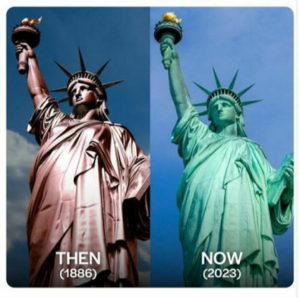
The Statue of Liberty was made with copper but due to oxidation, it turned green.

When the “Lady in the Harbor” first arrived in New York in 1886, she didn’t look like the mint-green icon we know today. In fact, for the first twenty years of her life, she stood as a towering, metallic beacon of reddish-gold. Designed by French sculptor Frédéric Auguste Bartholdi and engineered by Alexandre Gustave Eiffel, the statue was a gift from France to America. To build her, Bartholdi chose copper for three practical reasons:

  • Malleability:It could be hammered into elaborate, thin sheets.
  • Weight:Copper is lighter than stone or bronze, making it easier to ship 350 individual pieces across the Atlantic.
  • Durability:It was strong enough to survive a 27-day ocean voyage and the harsh winds of the harbor.

When she was unveiled on October 28, 1886, her skin—made of 300 copper sheets roughly the thickness of two pennies—shone with a bright, metallic brown luster. The transformation from “penny-colored” to “patina-green” wasn’t planned. Bartholdi actually expected the statue to age into a deeper, darker red. However, the unique environment of New York Harbor—a mix of salt air, moisture, and industrial pollution—triggered a process called oxidation.

The Timeline of Change:

  1. 1886–1900:The bright copper dulled into a dark, muddy brown.
  2. 1903:The first hints of a light green crust, or “patina,” began to appear.
  3. 1906:The color change was so controversial that Congress nearly stepped in. They appropriated $62,000 to paint the statue back to its original color, but the public protested, calling the idea “sacrilege.”
  4. 1910–1920:The statue was a patchy mix of brown and green until 1920, when the oxidation was complete, leaving her entirely teal.

While we now view the green color as iconic, it actually serves a vital structural purpose. The layer of verdigris (the green patina) acts as a protective shield. It seals the copper underneath, preventing the metal from further corrosion and weathering.  By the time the color fully changed, a new generation of immigrants had arrived in America seeing a green statue.