


Learners Live

Microsoft to Build Dedicated AI Factory Campus in Texas

Crusoe, the AI factory company, announced the development of a new, dedicated AI factory campus in Abilene, Texas. Supporting large scale AI workloads for Microsoft, the 900 MW site includes two new buildings and an onsite power plant to support grid resilience. The new campus is located adjacent to Crusoe’s existing Abilene AI factory infrastructure, bringing the total projected capacity across the full Abilene site to 2.1 gigawatts (GW). Land clearing and site preparation for the new campus are already underway, with the first building expected to be energized in mid-2027, continuing Crusoe’s record-setting pace that energized the first two buildings of the Abilene campus in under one year. The first eight buildings of Crusoe’s existing data center campus in Abilene are expected to deliver up to 32% of the City of Abilene’s and up to 25% of Taylor County’s current FY 2025 Budgeted Property Tax Revenue. Microsoft to Build Dedicated AI Factory Campus in Texas – electrifiED
Guess How Much Big Tech Will Spend on AI This Year

Four of the largest tech companies in the world project that they’ll spend roughly $650 billion combined on AI infrastructure in 2026, representing a historic ball-out for corporate capital expenditures, Bloomberg reported Here’s who’s spending what:

  • Taking the cake, Amazon announced Thursday that it’s planning to drop $200 billion on AI, chips, robotics, and satellites.
  • A day earlier, Alphabet said its capital expenditures could reach $185 billion, blowing past estimates.
  • Last week, Meta pegged its capex as high as $135 billion—an 87% jump from the year prior—driven by the company’s goal of achieving AI superintelligence.
  • Microsoft is expected to spend nearly $105 billion during its fiscal year ending in June.

Big Tech to spend $650 billion on AI in 2026, per Bloomberg

Consortium Acquires Aligned Data Centers in $40B Deal by Michelle Chapman

A group including BlackRock, Nvidia, and Microsoft is buying Aligned Data Centers in an approximately $40 billion deal in an effort to expand next-generation cloud and artificial intelligence infrastructure. The acquisition comes amid a flurry of deals in recent months involving top AI developers that are flooding the booming AI sector with resources and money, and addressing resources — such as electricity and infrastructure — needed to support such technology. Last month, OpenAI and Nvidia announced a $100 billion partnership that will add at least 10 gigawatts of data center computing power.  Consortium Acquires Aligned Data Centers in $40B Deal – electrifiED

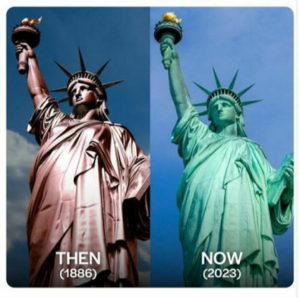
The Statue of Liberty was made with copper but due to oxidation, it turned green.

When the “Lady in the Harbor” first arrived in New York in 1886, she didn’t look like the mint-green icon we know today. In fact, for the first twenty years of her life, she stood as a towering, metallic beacon of reddish-gold. Designed by French sculptor Frédéric Auguste Bartholdi and engineered by Alexandre Gustave Eiffel, the statue was a gift from France to America. To build her, Bartholdi chose copper for three practical reasons:

  • Malleability:It could be hammered into elaborate, thin sheets.
  • Weight:Copper is lighter than stone or bronze, making it easier to ship 350 individual pieces across the Atlantic.
  • Durability:It was strong enough to survive a 27-day ocean voyage and the harsh winds of the harbor.

When she was unveiled on October 28, 1886, her skin—made of 300 copper sheets roughly the thickness of two pennies—shone with a bright, metallic brown luster. The transformation from “penny-colored” to “patina-green” wasn’t planned. Bartholdi actually expected the statue to age into a deeper, darker red. However, the unique environment of New York Harbor—a mix of salt air, moisture, and industrial pollution—triggered a process called oxidation.

The Timeline of Change:

  1. 1886–1900:The bright copper dulled into a dark, muddy brown.
  2. 1903:The first hints of a light green crust, or “patina,” began to appear.
  3. 1906:The color change was so controversial that Congress nearly stepped in. They appropriated $62,000 to paint the statue back to its original color, but the public protested, calling the idea “sacrilege.”
  4. 1910–1920:The statue was a patchy mix of brown and green until 1920, when the oxidation was complete, leaving her entirely teal.

While we now view the green color as iconic, it actually serves a vital structural purpose. The layer of verdigris (the green patina) acts as a protective shield. It seals the copper underneath, preventing the metal from further corrosion and weathering.  By the time the color fully changed, a new generation of immigrants had arrived in America seeing a green statue.