Learners Live

Dallas Fed Survey: War Uncertainty Capping Firms’ Ambitions by Geert De Lombaerde

Seven out of 10 oil-and-gas executives surveyed by the Federal Reserve Bank of Dallas think the price of a barrel of West Texas Intermediate (WTI), which flirted with $100 in the last 2 weeks, will finish 2026 below $80. But with the war with Iran “wreaking havoc” in commodity markets, most firms aren’t rushing to overhaul their 2026 production plans.Fed researchers’ quarterly survey of industry players from about 130 companies in Texas and parts of Louisiana and New Mexico showed that the average WTI price forecast for year-end is around $74. That’s up significantly from the $62 outlook from 3 months ago and well below the roughly $94/bbl at which WTI was being priced during the Fed’s survey period earlier this month. At $74, WTI would also be at a price high enough for most production to be profitable. Executives are more positive about the mid- and longer-term price outlook for natural gas than they are for oil. Dallas Fed survey: War uncertainty capping firms’ ambitions | Oil & Gas Journal

For more details from the survey, click here.

US Energy Department Reorganization Signals Major Policy Shift to Nuclear and Gas

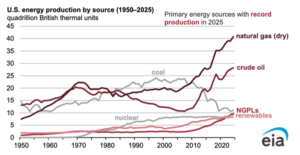
The U.S. Department of Energy (DOE) has announced a significant shift in its energy policy, moving away from renewable energy sources like solar and wind and towards baseload power sources such as natural gas and nuclear power. This decision involves the reorganization of nearly $84 billion in loans and conditional commitments, with approximately $9.5 billion in subsidies for wind and solar projects being eliminated. The DOE’s new focus is on supporting the private sector through energy projects that provide consistent power rather than intermittent generation. This shift is part of a broader policy to enhance energy security and domestic production, as outlined by Secretary of Energy Chris Wright. US Energy Department Reorganization Signals Major Policy Shift to Nuclear and Gas → Energy

Coal Plant to be Transformed into Gas-Powered Data Center Campus

 Homer City Redevelopment (HCR) and Kiewit Power Constructors Co. (Kiewit) announced the future of the former Homer City Generating Station. Homer City – previously the largest coal-burning power plant in Pennsylvania – will be transformed into a more than 3,200-acre natural gas-powered data center campus, designed to meet the growing artificial intelligence (AI) and high-performance computing (HPC) needs of the innovative technology companies shaping America’s digital future. GE Vernovawill provide seven high-efficiency 7HA.02 hydrogen-enabled, gas-fired turbines, with the first deliveries expected to begin in 2026.  Coal Plant to be Transformed into Gas-Powered Data Center Campus – electrifiED

The Statue of Liberty was made with copper but due to oxidation, it turned green.

When the “Lady in the Harbor” first arrived in New York in 1886, she didn’t look like the mint-green icon we know today. In fact, for the first twenty years of her life, she stood as a towering, metallic beacon of reddish-gold. Designed by French sculptor Frédéric Auguste Bartholdi and engineered by Alexandre Gustave Eiffel, the statue was a gift from France to America. To build her, Bartholdi chose copper for three practical reasons:

  • Malleability:It could be hammered into elaborate, thin sheets.
  • Weight:Copper is lighter than stone or bronze, making it easier to ship 350 individual pieces across the Atlantic.
  • Durability:It was strong enough to survive a 27-day ocean voyage and the harsh winds of the harbor.

When she was unveiled on October 28, 1886, her skin—made of 300 copper sheets roughly the thickness of two pennies—shone with a bright, metallic brown luster. The transformation from “penny-colored” to “patina-green” wasn’t planned. Bartholdi actually expected the statue to age into a deeper, darker red. However, the unique environment of New York Harbor—a mix of salt air, moisture, and industrial pollution—triggered a process called oxidation.

The Timeline of Change:

  1. 1886–1900:The bright copper dulled into a dark, muddy brown.
  2. 1903:The first hints of a light green crust, or “patina,” began to appear.
  3. 1906:The color change was so controversial that Congress nearly stepped in. They appropriated $62,000 to paint the statue back to its original color, but the public protested, calling the idea “sacrilege.”
  4. 1910–1920:The statue was a patchy mix of brown and green until 1920, when the oxidation was complete, leaving her entirely teal.

While we now view the green color as iconic, it actually serves a vital structural purpose. The layer of verdigris (the green patina) acts as a protective shield. It seals the copper underneath, preventing the metal from further corrosion and weathering.  By the time the color fully changed, a new generation of immigrants had arrived in America seeing a green statue.