Learners Live

Keeping Players Cool: The Critical Role of Shade Structures in Pickleball’s Rise

Pickleball is more than just a fleeting trend. According to the Sports and Fitness Industry Association, pickleball participation increased by 51.8% from 2022 to 2023 and by 223.5% over the last three years, with increased participation from every age group.  As a result, the demand for new courts is skyrocketing, with cities, park systems, and private developers working to build facilities catering to both recreational players and elite competitors. However, one major factor is essential to these outdoor spaces’ long-term success and usability: protection from extreme heat.  The trend of courts with shade structures reflects an industry-wide shift toward more innovative and safer designs. aces’ long-term success and usability: protection from extreme heat.Shade Structures Play A Critical Role In The Rise Of Pickleball


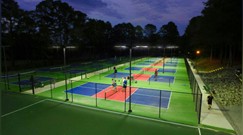
Pickleball & Tennis Court Illumination by U.S. Architectural Lighting

U. S. Architectural Lighting recently introduced Baseline – Pickleball & Tennis Court Lighting. Designed specifically for the court, Baseline uses a Type IV CL precision optic designed especially to meet IESNA / USA Pickleball / USTA Standard Performance Criteria for court photometrics. The luminaires distribute uniform light across the court surface without creating hot spots. To minimize glare, the light is directed at a low angle onto the court surface avoiding direct glare into the eyes of the players to prevent discomfort or distractions during play. The Baseline is available in five sizes in wattages from 85W to 550W, with up to four fixtures per pole, in parallel assembly arrangements, allowing a wide range of lumen packages. https://usaltg.com/product/bas/

 

That’s one small step for man, one giant leap for mankind – The last time human beings headed moonward was on the Apollo 17 flight that launched Dec. 7, 1972—before any of the Artemis II crew members were born. Today’s crew will not land on the moon—they won’t even orbit the moon. But they will whip around the lunar far side, on a shakedown mission test-flying the Orion spacecraft. This is essential preparatory work for achieving NASA’s bigger lunar goals. Next year there will be another test flight in low Earth orbit during the flight of Artemis III, followed by up to two moon landings by Artemis IV and V in 2028, and annual landings thereafter. Unlike the Apollo program, Artemis aims not just for the so-called flags-and-footprints model of short, one- to three-day stays on the moon, but for a long-term presence at a long-term moon base in the south lunar pole, where deposits of ice can provide drinkable water, breathable oxygen, and oxygen-hydrogen rocket fuel. Very much like the Apollo program, Artemis finds itself in a closely watched moon race, not with the old Soviet Union this time, but with China, which has announced its intention to have astronauts on the moon by 2030. The U.S. is not going it alone this time, however. While Apollo was an entirely American enterprise, Artemis flies under the flag of 60 countries, signatories to the Artemis Accords, an international pact whose members vow to support the peaceful exploration of space and contribute money, modules, and astronauts to the Artemis cause. Artemis II Has Launched. Here’s Everything You Need to Know