


Something to Think About… Who’s Going to Teach Our Kids? by Bill Attardi

Good question, huh. Better question is how are they going to learn in this rapidly accelerating digital age? Before we can answer these questions, what’s changing on the learning front? (By the way, that’s why I created LearnersLive.com, to encourage deep learning)
Learning is something we should do every day of our lives…………well, that’s a should and may not be a could. So how do we learn? Maybe how did and will we learn? More questions… sorry about that. Some answers………. Let’s look at four traditional pillars of learning and how artificial intelligence (AI) is not just assisting them, but rapidly replacing them:
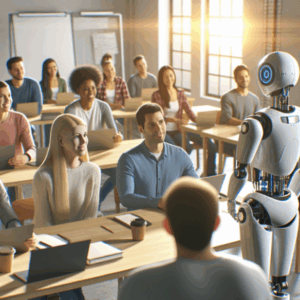
- The Teachers: Many Teachers in our life from grade school thru higher education stood in front of the classroom and learned us: Reading, wRiting and aRithmetic, remember? They were the primary drivers in making us smarter. Well, AI may be replacing us. AI-powered Robots could be standing in front of the class with unmatched expertise, access to big data, all the knowledge ever recorded, a higher degree of teaching capability that can customize instruction to every single student simultaneously. Written assignments will be analyzed for clarity, grammar, and style, and suggesting improvements no human could match in speed and scale never seen before. The traditional teaching paradigm is crumbling.
- The Public Library: The beautiful grand building we used to bike to, flip through card catalogs, and pray the book wasn’t checked out. The tactile process looking for information, searching for a book, an article, a paper, with the right enlightenment, to learn what we did not know or confirm what we did know. Today it’s e-books………..changing out reading behavior but it’s still a book. Who will go to that Library anymore when the AI Library is accessible to everyone. A vast “Big Data” library containing everything ever written, indexed perfectly, accessible instantly to everyone. The days of hunting and gathering information are over. You can go to the AI Library in your pajamas and learn.
- The Encyclopedia: The multi-volume encyclopedia was your personal home library of information. We learned general background information on most topics from a collection of books on our shelf at home. The biggest benefit: it was all in alphabetical order, to make it easy to find stuff. Talk about the ultimate low-tech hack for finding stuff. When you think about it, how smart was that back then……..really? Try selling your old Encyclopedia Britannica today on eBay. Fuggeddaboudit! Forget about flipping through volumes of information for hours. Just prompt AI, and it retrieves precise answers to anything you want to know instantly.
- The News & Media: Communications vehicles from newspapers to radio, to TV, to cable, to social media, to podcasts, etc., we’ve always brainstormed ideas and information to spark debate or for insight into current events. Not going away…….actually expanding, reaching more people in changing communications formats, some not currently known. Many have walked away from TV news and newspapers and get their news on social media right now. AI will be the driving force behind the quality of the information we will receive in the future. AI aggregates, compares and evaluates all that thinking now, helping us form sharper, more accurate conclusions. In such a divided world, pray that this is a way to flag bias, to cross-check facts, to highlight contradictions. To help us cut through the noise to find the signal in world events. Perhaps finding the truth won’t be so challenging. This could be the greatest contribution AI will ever make. How good is that!
Maybe you noticed, I reference artificial intelligence (AI) a lot. I believe it is the most powerful learning tool ever created. It can make us all smarter……isn’t that what learning is all about? AI strengthens our written and oral communication skills, supercharges our critical thinking, increases our competency, ultimately boosts our confidence to accomplish more than we ever thought possible.
You won’t lose your job to AI—you’ll ‘lose your job to somebody who uses AI’. Jensen Huang, Nvidia CEO
Brace yourself folks, Robots, Smart Robots powered by AI may, no, will be teaching our kids. Not only in the classroom but you will buy RoboAI to help your kids learn at home too.
Challenge me, please… if you do not agree with any of this.
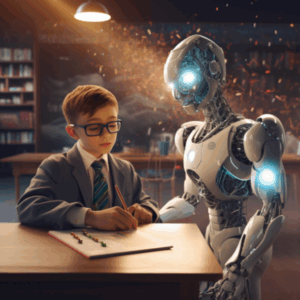
But in closing, I do have a warning. In this high-tech digital age, we are all addicted to our machines and devices. Hard to teach our kids to put down that smart phone or stop with the social media jazz when we are so dependent on it too. Communications are best practiced one-on-one / person-to-person. Connecting with people emotionally as well as intellectually. My concern going forward is the danger of a most essential part of everyone’s overall health: the personal development & growth of human relationships. That may be where artificial intelligence has its limitations.
 Robot umpires
 Eighty percent of humans will engage with smart robots on a daily basis, and one in 20 supply chain managers will manage robots, rather than humans, by 2030, according to Gartner, Inc. Organizations are placing greater emphasis on enhancing the capabilities of their existing workforce by supplementing with robotics due to factors like labor scarcity and rising costs. Smart robots have been identified by chief supply chain officers (CSCOs) as an important investment area, though many acknowledge their organization lacks internal robotics expertise to maximally leverage these innovative technologies. While it won’t be necessary for supply chain managers to have the engineering skills required to build robots, they will need a general technical understanding of what the robots can do and how they work together with other robots and people. This knowledge will be crucial for understanding the business problems robots can reasonably address and provide this guidance to business leaders
  Hyundai celebrated the opening of its new $7.6 billion electric vehicle factory in Georgia on Wednesday by announcing plans to expand its production capacity by two-thirds to a total of 500,000 vehicles per year. The newly announced Georgia expansion is part of $21 billion in U.S. investments over the next three years that Hyundai announced at the White House. Hyundai began producing EVs just shy of six months ago at its sprawling manufacturing plant in southeast Georgia. More than 1,200 people are working there. Hyundai employees worked the assembly line alongside hundreds of robots that stamp sheets of steel into fenders and door panels, weld and paint auto bodies and even park finished vehicles awaiting their final inspections.