


Learners Live

GM Raided Silicon Valley to Build Its New AI Team. Here’s What It’s Doing

In the last eight months, GM has made nearly a dozen hires from top tech companies—from Google to Meta to AWS—with the aim of building a small but elite AI center of excellence, much of it based in Mountain View, CA. For many companies, the challenge posed by artificial intelligence rests in how to make practical use of it in operations. For many companies, the challenge posed by artificial intelligence rests in how to make practical use of it in operations. For a company like GM, that could mean incorporating AI into back-office workflows, but also into future fleets of autonomous vehicles, manufacturing robots and even motor sports. Using robots and other tech to make manufacturing more efficient—a goal GM has worked on for decades—will be even more critical as the company looks to bump up U.S. production and mitigate the cost of President Trump’s tariffs. GM Raided Silicon Valley to Build Its New AI Team. Here’s What It’s Doing. – WSJ
The Great Reshoring: Wake Up, America, Your Factory Floor Is Calling by Alexander De Ridder

The real AI revolution isn’t happening in Silicon Valley conference rooms — it’s about to explode on America’s factory floors. This isn’t your standard automation upgrade. AI-powered manufacturing is like giving every worker a superpower. Suddenly your maintenance tech isn’t just fixing machines — it’s preventing breakdowns before they happen. Your quality control is catching defects that human eyes can’t even see. Your production planning is adjusting to market changes in real time. But here’s the best part: AI turns your biggest cost center—labor—into your greatest asset. Instead of replacing workers, AI elevates them. It handles the mind-numbing routine tasks while your people focus on what humans do best: innovating, problem-solving, and making the kind of judgment calls no algorithm can match. This approach not only creates new jobs but also transforms existing roles into hybrid positions that synergize human and AI capabilities.    The great reshoring: Wake up, America, your factory floor is calling

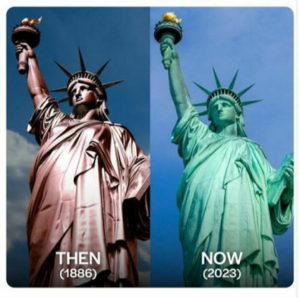
The Statue of Liberty was made with copper but due to oxidation, it turned green.

When the “Lady in the Harbor” first arrived in New York in 1886, she didn’t look like the mint-green icon we know today. In fact, for the first twenty years of her life, she stood as a towering, metallic beacon of reddish-gold. Designed by French sculptor Frédéric Auguste Bartholdi and engineered by Alexandre Gustave Eiffel, the statue was a gift from France to America. To build her, Bartholdi chose copper for three practical reasons:

  • Malleability:It could be hammered into elaborate, thin sheets.
  • Weight:Copper is lighter than stone or bronze, making it easier to ship 350 individual pieces across the Atlantic.
  • Durability:It was strong enough to survive a 27-day ocean voyage and the harsh winds of the harbor.

When she was unveiled on October 28, 1886, her skin—made of 300 copper sheets roughly the thickness of two pennies—shone with a bright, metallic brown luster. The transformation from “penny-colored” to “patina-green” wasn’t planned. Bartholdi actually expected the statue to age into a deeper, darker red. However, the unique environment of New York Harbor—a mix of salt air, moisture, and industrial pollution—triggered a process called oxidation.

The Timeline of Change:

  1. 1886–1900:The bright copper dulled into a dark, muddy brown.
  2. 1903:The first hints of a light green crust, or “patina,” began to appear.
  3. 1906:The color change was so controversial that Congress nearly stepped in. They appropriated $62,000 to paint the statue back to its original color, but the public protested, calling the idea “sacrilege.”
  4. 1910–1920:The statue was a patchy mix of brown and green until 1920, when the oxidation was complete, leaving her entirely teal.

While we now view the green color as iconic, it actually serves a vital structural purpose. The layer of verdigris (the green patina) acts as a protective shield. It seals the copper underneath, preventing the metal from further corrosion and weathering.  By the time the color fully changed, a new generation of immigrants had arrived in America seeing a green statue.