US Open Set Up for Dark Sky-Friendly Outdoor Lights by Adithi Ramakrishnan

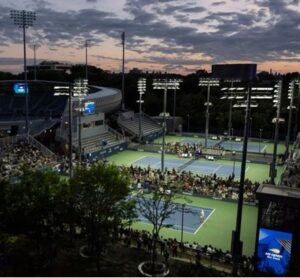 When the court lights flicker on at the U.S. Open, tennis stars shine under illumination designed to cut light pollution. The U.S. Tennis Association swapped metal halide bulbs for shielded wedge-shaped LED lights. The complex’s 17 tournament courts and five practice courts were approved as dark sky-friendly last year. Most arenas make the change during scheduled maintenance and renovation, working with sports lighting company Musco. The company lights over 3,000 venues a year including college football stadiums, tennis courts and rail yards. US Open Set Up for Dark Sky-Friendly Outdoor Lights – tEDmag
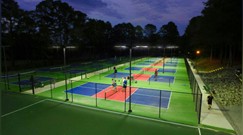 U. S. Architectural Lighting recently introduced Baseline – Pickleball & Tennis Court Lighting. Designed specifically for the court, Baseline uses a Type IV CL precision optic designed especially to meet IESNA / USA Pickleball / USTA Standard Performance Criteria for court photometrics. The luminaires distribute uniform light across the court surface without creating hot spots. To minimize glare, the light is directed at a low angle onto the court surface avoiding direct glare into the eyes of the players to prevent discomfort or distractions during play. The Baseline is available in five sizes in wattages from 85W to 550W, with up to four fixtures per pole, in parallel assembly arrangements, allowing a wide range of lumen packages.