Learners Live

Microsoft to Build Dedicated AI Factory Campus in Texas

Crusoe, the AI factory company, announced the development of a new, dedicated AI factory campus in Abilene, Texas. Supporting large scale AI workloads for Microsoft, the 900 MW site includes two new buildings and an onsite power plant to support grid resilience. The new campus is located adjacent to Crusoe’s existing Abilene AI factory infrastructure, bringing the total projected capacity across the full Abilene site to 2.1 gigawatts (GW). Land clearing and site preparation for the new campus are already underway, with the first building expected to be energized in mid-2027, continuing Crusoe’s record-setting pace that energized the first two buildings of the Abilene campus in under one year. The first eight buildings of Crusoe’s existing data center campus in Abilene are expected to deliver up to 32% of the City of Abilene’s and up to 25% of Taylor County’s current FY 2025 Budgeted Property Tax Revenue. Microsoft to Build Dedicated AI Factory Campus in Texas – electrifiED

Dallas Market Center Announces Major Expansion

Dallas Market Center announced a dramatic expansion of the number of Design showrooms located inside its Interior Home + Design Center (IHDC). More than 100 brands, represented inside multiple showrooms, will move into custom spaces on the first and second floors of the building in the first half of 2026. This is the largest project for the development of new showrooms inside Dallas Market Center in more than a decade. Upcoming trade events at Dallas Market Center include Design Days, April 14-15; Total Home & Gift Market, June 24-30; Lightovation, June 24-27; and Design + Build Day at Lightovation, June 23. Dallas Market Center Announces Major Expansion – tEDmag

Google to Invest $40B in AI Data Centers, Workforce Training Across Texas by Claire Hao, James Osborne

Google plans to invest $40 billion into artificial intelligence data centers and related workforce training across Texas through 2027. That includes plans to build three new data centers – two in Haskell County and one in Armstrong County. It’s the latest massive investment from tech giants racing to surpass each other in the development of artificial intelligence. Amid this rush, Texas has emerged as one of the most attractive states for new data centers, given its ample land, relatively cheap electricity for large industrial users and abundant energy resources.  Google to invest $40B in AI data centers, workforce training across Texas

Tesla Launches Robotaxi Program in Austin, Texas

Musk appears to be on the verge of making his robotaxi vision a reality with a test run of a small squad of self-driving cabs in Austin, Texas, that began Sunday with customers paying a $4.20 flat fee! Reaching a million may take a year or more, however, although the billionaire should be able to expand the service this year if the Austin demo is a success. The stakes couldn’t be higher, nor the challenges. Rival Waymo was busy deploying driverless taxis in Los Angeles, San Diego, Austin and other cities by using a different technology that allowed it to get to market faster. It just completed its 10 millionth paid ride. Musk says the robotaxis will be running on an improved version of Full Self-Driving and the cabs will be safe. He also says the service will be able to expand rapidly around the country. His secret weapon: Millions of Tesla owners now on the roads. He says an over-the-air software update will soon allow them to turn their cars into driverless cabs and start a side business while stuck at the office for eight hours or on vacation for a week. “Instead of having your car sit in the parking lot, your car could be earning money,” Musk said earlier this year, calling it an Airbnb model for cars. Musk finally rolls out his driverless Tesla taxis after years of promises | AP News

The Drone-Delivery Service Beating Amazon to Your Front Door

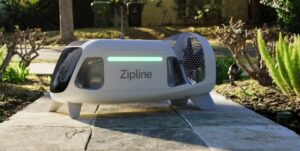
Soon your burrito bowl could arrive via the sky. Zipline’s drones make deliveries by lowering small coolers on 300-foot cables. A drone delivery startup Zipline is in the flying delivery race—competitors include Amazon and Google parent Alphabet—has emerged as a front-runner. For now, initial commercial testing in the U.S. is happening in Pea Ridge and Mesquite, Texas, just outside Dallas. Walmartis the only retail operation Zipline delivers for in the U.S. at present. For future partners, Zipline has designed a small pickup kiosk that can be installed just outside any building.  Alphabet’s Wing drone service is already in the Dallas-Fort Worth area, delivering from 18 Walmarts to 40 nearby towns and cities within the drones’ six-mile range. Amazon is operating its drone delivery service in College Station, Texas, and an area near Phoenix, but in terms of scale, the online retail giant remains a distant third. The Drone-Delivery Service Beating Amazon to Your Front Door – WSJ
The Statue of Liberty was made with copper but due to oxidation, it turned green.

When the “Lady in the Harbor” first arrived in New York in 1886, she didn’t look like the mint-green icon we know today. In fact, for the first twenty years of her life, she stood as a towering, metallic beacon of reddish-gold. Designed by French sculptor Frédéric Auguste Bartholdi and engineered by Alexandre Gustave Eiffel, the statue was a gift from France to America. To build her, Bartholdi chose copper for three practical reasons:

  • Malleability:It could be hammered into elaborate, thin sheets.
  • Weight:Copper is lighter than stone or bronze, making it easier to ship 350 individual pieces across the Atlantic.
  • Durability:It was strong enough to survive a 27-day ocean voyage and the harsh winds of the harbor.

When she was unveiled on October 28, 1886, her skin—made of 300 copper sheets roughly the thickness of two pennies—shone with a bright, metallic brown luster. The transformation from “penny-colored” to “patina-green” wasn’t planned. Bartholdi actually expected the statue to age into a deeper, darker red. However, the unique environment of New York Harbor—a mix of salt air, moisture, and industrial pollution—triggered a process called oxidation.

The Timeline of Change:

  1. 1886–1900:The bright copper dulled into a dark, muddy brown.
  2. 1903:The first hints of a light green crust, or “patina,” began to appear.
  3. 1906:The color change was so controversial that Congress nearly stepped in. They appropriated $62,000 to paint the statue back to its original color, but the public protested, calling the idea “sacrilege.”
  4. 1910–1920:The statue was a patchy mix of brown and green until 1920, when the oxidation was complete, leaving her entirely teal.

While we now view the green color as iconic, it actually serves a vital structural purpose. The layer of verdigris (the green patina) acts as a protective shield. It seals the copper underneath, preventing the metal from further corrosion and weathering.  By the time the color fully changed, a new generation of immigrants had arrived in America seeing a green statue.