Learners Live

Trump Announces ‘Massive’ Trade Deal with Japan with 15% Tariffs by Lim Hui Jie

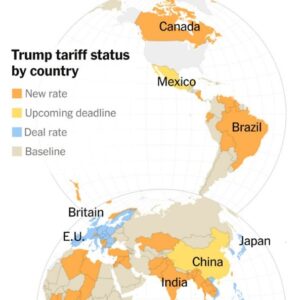
President Donald Trump on Tuesday stateside announced that he had made the “largest Deal ever” with Japan, that involves “reciprocal” tariffs of 15% on the country’s exports to the U.S.

  • Trump said that Japan will invest $550 billion into the United States, adding that the U.S. will “receive 90% of the Profits.”
  • He also said Japan will “open their Country to Trade including Cars and Trucks, Rice and certain other Agricultural Products, and other things.”
  • The U.S. president added that the deal would also create “Hundreds of Thousands of Jobs.”  Trump announces ‘massive’ trade deal with Japan with 15% tariffs

Google to Fund NECA Training Program

Google is announcing a new paper and support for an effort to train 100,000 electrical workers and 30,000 new apprentices in the United States. This is Google’s news release: AI presents the United States with a generational opportunity for extraordinary innovation and growth. The deployment of AI will grow the American economy, create jobs, accelerate scientific advances and more. Fully realizing these opportunities requires an effort to rapidly increase the capacity of the nation’s existing, sometimes antiquated energy system. This in turn requires accelerating innovation and investment in advanced energy technologies; optimizing use of the existing grid and unlocking construction of new transmission infrastructure; and developing the labor force needed to build new energy infrastructure. Through shared public and private efforts to introduce and support training programs like this one, the U.S. can develop a model for training the next generation workforce. Google to Fund NECA Training Program – electrifiED

White House Narrows April 2 Tariffs

The White House is narrowing its approach to tariffs set to take effect on April 2, likely omitting a set of industry-specific tariffs while applying reciprocal levies on a targeted set of nations that account for the bulk of foreign trade with the U.S.  President Trump has declared his April 2 deadline to be “Liberation Day” for the U.S., when he will put in place what is called reciprocal tariffs that seek to equalize U.S. tariffs with the duties charged by trading partners, as well as tariffs on sectors like automobiles, pharmaceuticals and semiconductors he repeatedly said would be enacted on that day. The administration is now focusing on applying tariffs to about 15% of nations with persistent trade imbalances with the U.S.  Despite economic concerns and global pushback, Trump reiterated his goal of using tariffs to restore trade balance and economic strength.  White House Narrows April 2 Tariffs – WSJ

The Genesis of the U.S. Space Force – On December 20, 2019, President Donald Trump signed the National Defense Authorization Act (NDAA) for Fiscal Year 2020, officially creating the United States Space Force, a new and independent branch of the U.S. military. The establishment of the Space Force marked a historic shift in how the U.S. views and manages its military operations in space, reflecting the growing importance of space as both a domain of strategic competition and national security. The Space Force is tasked with ensuring the U.S. maintains its superiority in space, focusing on both the defense of space assets and the development of offensive capabilities. Its mission includes:

  1. Space Operations: Overseeing space-based systems, such as satellites, that provide essential services to the U.S. military, including communication, reconnaissance, and missile defense.
  2. Space Security: Protecting U.S. space infrastructure from threats, including anti-satellite weapons, cyberattacks, and other potential forms of disruption by adversarial nations.
  3. Space Research and Development: Developing and deploying cutting-edge space technologies, including space-based defense systems, that ensure the U.S. maintains an edge in space exploration and military operations.
  4. Supporting National Defense: Integrating space capabilities into broader national defense strategies, ensuring that U.S. forces can operate effectively in space as part of a multi-domain approach to warfare.

The Space Force is designed to streamline and strengthen the U.S. military’s space operations, which were previously under the purview of the U.S. Air Force. By separating space operations into a distinct branch, the government hoped to increase focus on space as a critical area of national defense and enhance the U.S. military’s ability to respond to emerging threats. Source: Day in History