


Learners Live

LEDucation Conference to Offer 39 Educational Sessions

Show organizers for the LEDucation 2026 Conference in New York released some additional information on what should be another packed event. This year’s conference will feature 39 educational sessions presented by recognized experts and thought leaders in their fields. Interactive virtual programming on April 9–10 will be followed by rich in-person sessions April 14–15. LEDucation offers a total of 42.5 continuing education credits. Key Highlights

  • The event features 39 educational sessions led by recognized experts, covering both technical and design aspects of lighting.
  • Virtual programming on April 9–10 provides deep dives into digital workflows, AI, 3D printing, and health lighting innovations.
  • In-person sessions on April 14–15 focus on practical design applications, regulatory compliance, and emerging industry trends.

Registration – LEDucation

Islandwide Blackout Hits Cuba As It Struggles with Deepening Energy Crisis by Milexsy Durán and Dánica Coto

Officials in Cuba reported an islandwide blackout Monday in the country of some 11 million people as its energy and economic crises deepen and its power grid continues to crumble. Cuba’s aging grid has drastically eroded in recent years, leading to daily outages and an increase in islandwide blackouts. But the government also has blamed its woes on a U.S. energy blockade after U.S. President Donald Trump in January warned of tariffs on any country that sells or provides oil to Cuba. The Trump administration is demanding that Cuba release political prisoners and move toward political and economic liberalization in return for a lifting of sanctions. Trump also has raised the possibility of a “friendly takeover of Cuba.” The Trump administration is looking for Cuban President Miguel Díaz-Canel to leave power as the United States continues to negotiate with the Cuban government about the island nation’s future. William LeoGrande, a professor at American University who has tracked Cuba for years said, “the economy could collapse just completely and then you would have social chaos and probably mass migration.” Islandwide blackout hits Cuba as it struggles with energy crisis | AP News

MicroLEDs: from Headlamps to the Data Center

When we think about the evolution of AI technology, developments in machine learning and large language models come readily to mind, as do the latest graphics processing units (GPUs), high-bandwidth memory (HBM), and exotic semiconductor technologies such as chiplets and heterogeneous integration.  But car headlamps? Automotive lighting is not usually seen as an inspiration for the next big thing in AI. Interestingly however, high-tech ‘adaptive beam’ front lights are proving the reliability and scalability of a valuable optical connectivity technology which could help data center operators to meet today’s challenges of increasing network bandwidth, efficiency and reliability. But let’s take a step back to understand how headlamps could possibly be relevant to the technology of AI data centers at: [News] MicroLEDs: from Headlamps to the Data Center – LEDinside

Light + Building 2026 Industry’s the Sector’s Pace of Innovation

Light + Building 2026 highlighted the remarkable pace at which innovation is currently advancing across the industry. From 8th to 13th March 2026, 1,927 exhibitors from 49 countries showcased a wide range of advanced technological solutions in Frankfurt – from the electrification and digital connectivity of buildings and urban spaces to sophisticated lighting and design concepts for architecture, urban development and interiors. Technologies such as artificial intelligence, bidirectional charging, multifunctional interfaces and connected lighting solutions featured prominently in many products, marking the next stage in the development of buildings, cities and lighting design. Light + Building 2026 industry’s the sector’s pace of innovation – A1 Lighting Magazine

U.S. Regular Gasoline Prices (dollars per gallon)

02/23/26 03/02/26 03/09/26 2 year ago year ago week ago
U.S. 2.937 3.015 3.502 0.126 0.433 0.487
East Coast
2.834 2.882 3.363 0.098 0.418 0.481
New England
2.852 2.878 3.352 0.170 0.391 0.474
CentralAtlantic
2.962 2.967 3.419 0.087 0.348 0.452
Lower Atlantic
2.748 2.830 3.330 0.089 0.467 0.500
Midwest
2.675 2.794 3.276 -0.011 0.377 0.482
Gulf Coast
2.532 2.644 3.109 0.164 0.429 0.465
RockyMountain
2.662 2.758 3.258 0.181 0.298 0.500
West Coast
4.111 4.160 4.690 0.394 0.591 0.530
West Coast
less California
3.723 3.791 4.215 0.353 0.535 0.424

Gasoline and Diesel Fuel Update – U.S. Energy Information Administration (EIA)

Seeking Standardization: Open Systems Are Becoming More Relevant by Craig DiLouie

As lighting systems evolve from simple illumination devices into connected infrastructure, the industry is placing more emphasis on open, interoperable standards. While many control platforms still rely on proprietary hardware and software, open standards are becoming increasingly relevant. A significant player in standards is Zhaga-D4i (zD4i). It combines a standardized plug-in interface for sensors and communication modules with a common digital language for data exchange. For electrical contractors, this framework can simplify installation, improve upgradability and create new opportunities for offering connected lighting solutions. To address this, Zhaga introduced Book 18 in 2018. Now in its fourth edition (released in 2025), Book 18 defines how a smart node physically attaches to an outdoor LED luminaire, receives power and exchanges digital information with the driver. In effect, Book 18 serves as the socket standard for modern connected outdoor lighting. Around the same time, the DALI Alliance expanded its DALI-2 standard to better support internet of things (IoT) and luminaire-level control. With Zhaga’s Book 18 managing the physical and electrical interface and the DALI Alliance’s D4i managing the digital handshake, the two organizations partnered to create the zD4i product certification. Seeking Standardization: Open systems are becoming more relevant | Craig DiLouie – Electrical Contractor Magazine

The Electric Grid Needs Huge Upgrades by Katherine Blunt & Jennifer Hiller

The U.S. power industry is embarking on an AI-driven expansion of the electric grid, a build-out that promises to be one of the most expensive since World War II. Utilities around the country are planning to spend tens of billions of dollars to build new high-voltage transmission lines to carry electricity from power plants over long distances. Many companies this year announced plans to substantially increase capital expenditures to build the new capacity, in large part to serve demand from data centers. The White House this month announced that seven of the nation’s largest tech companies had agreed to pay for all the costs associated with powering new data centers. The Electric Grid Needs Huge Upgrades. No One Knows Who Will Pay for Them. – WSJ

New Vapor Tight Extruded Luminaires from LEDvance

These CCT and wattage selectable luminaires are tough enough for almost any wet or dusty location. Featuring a one-piece body, end-to-end wiring, and 0-10V dimming down to 10% for extra energy savings, they install in minutes. LEDVANCE Dual Selectable Extruded Vapor Tight combines modern scale design with ease of installation featuring end to end wiring and full mounting channel. Available in 3 sizes, 3 CCT, and up to 13,750 lumens, its perfect for outdoor canopies, tunnels, stairwells, and a variety of other wet or dusty applications. Every fixture is backed by rigorous testing, North‑American service teams and more than a century of lighting expertise. Contact LEDVANCE – Vapor Tight Extruded
EV Charger Rebate Trends for 2026 by BriteSwitch

2025 was a complicated year for the EV industry. EV sales fell sharply in Q4, and for those in the charging business, the headlines may have felt unsettling. But vehicle sales and the charging business are telling two very different stories. The US added 17% more charging ports, and utilization continues to climb. Electrek reported 141 million charging sessions in 2025, a 30% increase over the previous year. There are more EVs on the road than ever, and drivers are using public charging stations more frequently. Rebates still play a crucial role in building up the EV charging infrastructure in North America, and they’re as strong as ever. We break down the five biggest EV charger rebate trends shaping 2026:

Signify Launches Brighter Lives, Better World 2030

Signify launched Brighter Lives, Better World 2030, a new program designed to expand the reach of impactful, energy and resource-efficient lighting to improve lives, save energy, and preserve resources. The program is supported by new initiatives that support customer sustainability ambitions. Focusing on customers’ most pressing challenges, Brighter Lives, Better World 2030 responds to rising demand for efficient, connected and electrified solutions. Addressing increasing demand for electricity1 and volatile pricing, resource scarcity and the need for healthier, safer, more resilient and livable environments – the program transforms the potential of light into meaningful impact. Progress on Signify’s Brighter Lives, Better World 2030 program will be reported on a quarterly basis, in line with the company’s financial results. Signify Launches Brighter Lives, Better World 2030 – tEDmag

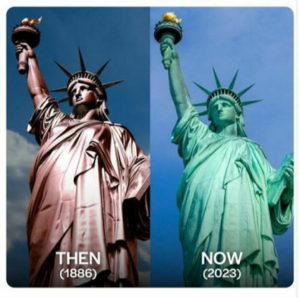
The Statue of Liberty was made with copper but due to oxidation, it turned green.

When the “Lady in the Harbor” first arrived in New York in 1886, she didn’t look like the mint-green icon we know today. In fact, for the first twenty years of her life, she stood as a towering, metallic beacon of reddish-gold. Designed by French sculptor Frédéric Auguste Bartholdi and engineered by Alexandre Gustave Eiffel, the statue was a gift from France to America. To build her, Bartholdi chose copper for three practical reasons:

  • Malleability:It could be hammered into elaborate, thin sheets.
  • Weight:Copper is lighter than stone or bronze, making it easier to ship 350 individual pieces across the Atlantic.
  • Durability:It was strong enough to survive a 27-day ocean voyage and the harsh winds of the harbor.

When she was unveiled on October 28, 1886, her skin—made of 300 copper sheets roughly the thickness of two pennies—shone with a bright, metallic brown luster. The transformation from “penny-colored” to “patina-green” wasn’t planned. Bartholdi actually expected the statue to age into a deeper, darker red. However, the unique environment of New York Harbor—a mix of salt air, moisture, and industrial pollution—triggered a process called oxidation.

The Timeline of Change:

  1. 1886–1900:The bright copper dulled into a dark, muddy brown.
  2. 1903:The first hints of a light green crust, or “patina,” began to appear.
  3. 1906:The color change was so controversial that Congress nearly stepped in. They appropriated $62,000 to paint the statue back to its original color, but the public protested, calling the idea “sacrilege.”
  4. 1910–1920:The statue was a patchy mix of brown and green until 1920, when the oxidation was complete, leaving her entirely teal.

While we now view the green color as iconic, it actually serves a vital structural purpose. The layer of verdigris (the green patina) acts as a protective shield. It seals the copper underneath, preventing the metal from further corrosion and weathering.  By the time the color fully changed, a new generation of immigrants had arrived in America seeing a green statue.