Learners Live

Successfully Incorporating AI Into Building by Gretchen Catlin

Operations Artificial Intelligence (AI) is emerging as one of the most practical tools: not as a replacement for skilled staff, but as a workforce multiplier that captures knowledge, sharpens decisions and extends the capacity of the teams we have. Key Takeaways:

  • With a large portion of the facilities workforce nearing retirement, AI can help preserve critical institutional knowledge before it is lost.
  • AI can improve facility operations by supporting predictive maintenance, analyzing data and streamlining everyday tasks such as communications, documentation and capital planning.
  • Organizations can successfully adopt AI by starting with small, practical applications while addressing cybersecurity, cost and workforce training considerations.

Successfully Incorporating AI Into Building Operations – Facilities Management Insights

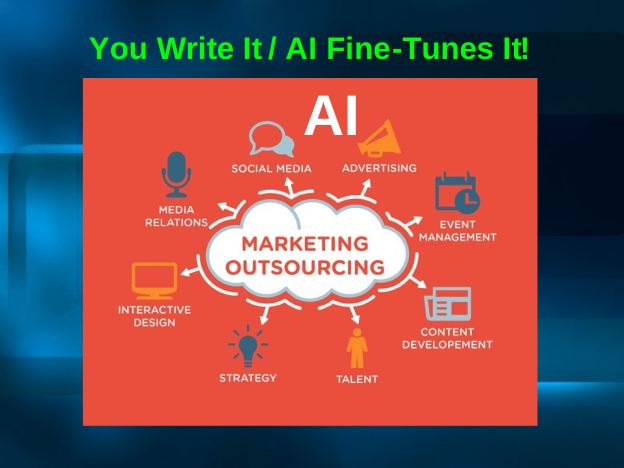
You Write it / AI Fine-Tunes it!

You Write it / AI Fine-Tunes it! – Learners Live 

Sponsored by Amerlux

Amerlux Corporate Video

No matter your job or position, your ability to communicate – whether in writing or speaking – at the highest level of your capability will determine your relationships and your success in those relationships. Competency to communicate effectively is a continuing learning process.  It’s a critical skill for success.  The more you do it, the more competent you become. Enter artificial intelligence… AI’s full impact on education—and life—is just beginning to unfold. But one thing is already clear: it can enhance everything we do. Start with your original ideas. Use AI to refine, elevate, and clarify. You write it, AI fine-tunes it! Practice this consistently, and you’ll do more than just communicate better. You’ll think better. You’ll learn faster. You’ll work smarter. And ultimately, you’ll succeed in ways you never thought possible.
A Leader’s Game Plan: How to Make More Time for the Most Important Tasks by Thomas G. Farrell

A well-conceived plan provides direction, helps identify potential challenges and increases the likelihood of success. A plan that mitigates operational tasks and affords more time for interpersonal relationship-building should be a centerpiece for any dynamic organizational leader. In any organizational leadership position, the key to success is engaging and inspiring staff, governance boards and constituent communities. This can only happen through visionary leadership and strategic thinking that is constantly communicated, organized, refined and adapted. Whether a private-sector corporation, public school district, private school, public agency, governing body or athletic team, engaging and communicating a shared vision of success to all stakeholders is the key for any organization. To truly become a transformational leader, your greatest success must come from how you connect with and empower people. How to make more time for the most important tasks

You Write it, AI Fine-Tunes It! by Bill Attardi

No matter your job or position, your ability to communicate – whether in writing or speaking – at the highest level of your capability will determine your relationships and your success in those relationships. Early on in life, most of us struggled with communicating our thoughts but you always knew developing that skill is essential.  Business, like life, is a team sport and engaging and working with others is an everyday occurrence.  The competency to communicate effectively is a continuing learning process.  It’s a critical skill for success.  The more you do it, the more competent you become.

Help is on the way. Enter AI – Artificial Intelligence.  Yes, AI, the most powerful learning tool ever created.  It can make you smarter, if you understand how it makes you learn.  At Monmouth University, we integrate AI into our oral and written communication assignments to help students excel. Oral communications take the form of creating a slide presentation analyzing real-world case studies.  Terrific learning experience to help them strengthen both their critical thinking and public speaking skills. We ask them to use AI to refine their delivery and content. For writing, we emphasize a critical process: original thought first. Write as you would have before AI ever existed, then feed your original work into AI and prompt AI to be your personal Writing Tutor to fine-tune it. This approach ensures you learn something new with every draft, steadily improving your writing skills and boosting your confidence. Again, it will make you smarter.

Why AI?

AI isn’t just a tech tool; it’s a game-changer for learning. It replaces those outdated methods with instant, powerful resources, accessible every time you have a need.

  • The Library – Once, we pored over books or today e-books for knowledge. AI’s vast “Big Data” library contains everything ever written, accessible in seconds. Now it’s all in the AI Library…
  • The Encyclopedia – We learned general background info on any topic from a collection of books in alphabetical order, to make it easy to find stuff. How nice was that… Fuhgeddaboudit….. Forget flipping through volumes of information for hours. Just prompt AI, and it retrieves precise answers instantly.
  • News & Media – From newspapers to social media and everything in between, we’ve always brainstormed ideas and information to spark debate or insight of current events. AI aggregates, compares and evaluates that thinking, helping you form sharper, more accurate conclusions. That is if ideology does not get in the way.
  • The Teachers – Many Teachers from grade school thru higher education all focused on Reading, wRiting and aRithmetic, right? Coaches, Tutors, Trainers, Teachers…all to make us smarter. Well, AI may be replacing us. Educators pass on what they know to help the learning process of others. Now, AI offers unmatched expertise, analyzing your writing for clarity, grammar, and style, and suggesting improvements no human could match in speed and scale never seen before.  So where do we teachers fit in?  Probably another blog… any suggestions?

Addressing AI Misuse

Since we are talking about education, let me end this blog by talking about the elephant in the room – Plagiarism – that is what it is and it has always been a problem.  Sure, some students will misuse AI to bypass learning, to cheat, to plagiarize an assignment. Nothing new here…….

I spend no time policing when a student cheats. That’s a personal choice for me. It’s their choice if they want to learn or not.  If they want to use AI to do all their work and learn nothing, they will find a way and it’s a losing battle for teachers, and frankly, a waste of time.  Instead, the focus should be on inspiring students to see AI’s value as a lifetime learning tool. When used correctly, AI doesn’t just help you complete assignments—it makes you smarter. The choice is simple: embrace AI to grow, or miss out on its transformative potential, is the message. Not everyone will buy in, but those who do will thrive in a world where lifelong learning is non-negotiable.  I still have faith in those that cheat.  Some are just not ready to accept that learning is a never-ending process and that there are no short-cuts. When they figure it out, they will be fine.

 The Future Is Here

AI’s full impact on education—and life—is just beginning to unfold. But one thing is already clear: it can enhance everything we do. Start with your original ideas. Use AI to refine, elevate, and clarify. You write it, AI fine-tunes it! Practice this consistently, and you’ll do more than just communicate better. You’ll think better. You’ll learn faster. You’ll work smarter. And ultimately, you’ll succeed in ways you never thought possible. Word of caution: connecting with people emotionally as well as intellectually is important for our overall health. Buona Salute!


 

The Critical Need for a Crisis Communication Plan for Your Business by Frank Grobmeier

What is one of the biggest mistakes any business can make? It’s believing that nothing bad will ever happen to it. As a result, leadership doesn’t prepare for the inevitable crisis. The reality is every business faces challenges that they never see coming. But taking a little time to prepare a crisis communication plan would allow them to quickly and effectively respond to their employees, customers and stakeholders with a unified message and the critical details that will protect its reputation, maintain public trust, and minimize negative impacts.

We’ve watched recent crises unfold, like the California wildfires and Hurricane Helene, which have shown us that unexpected situations can alter our day-to-day business dramatically. However, natural disasters are not the only unexpected things that can impact our business. Other crisis situations can include corporate scandals, bankruptcies, product recalls, severe weather closings, and technical failures, just to name a few.

A thorough crisis communication plan provides your employees with the knowledge and direction that guides how they appropriately respond to customers, stakeholders, and media requests.  A strong plan can help your organization maintain operational efficiency during a crisis and provide employees with clear guidelines on how to engage with first responders, contractors, and media, while minimizing damage and restoring regular operations.

The following 10 simple steps can help you develop a comprehensive crisis communication plan:

  1. Anticipate the crisis. Take your head out of the sand and begin to list out all the potential crisis situations that could put your business at risk. Today’s “anticipations” could be tomorrow’s “situations.”
  2. Assemble a crisis team. No matter how competent you are as a leader, a crisis requires multiple people to execute the plan. You should also identify backup personnel for each of those roles in anticipation of what could happen if someone on the crisis team is directly involved in the crisis.
  3. Decide on a spokesperson for the organization. This person will provide a unified message to the media, stakeholders, and if applicable, shareholders to update these key constituencies on the situation.
  4. Assign a leadership point person. This role is different from the spokesperson. This point person oversees managing the crisis situation while the spokesperson is solely responsible for informing people and speaking on behalf of the business.
  5. Create a place to centrally store the crisis communication plan. This will need to be a software / cloud storage area that can be readily accessed by the crisis management team. You will also need to develop email groups / text chains /  virtual links that the team can use to communicate with each other during a crisis situation.
  6. Protect employees. The first, critical piece of every crisis plan is to ensure the safety and security of your employees. Create an action plan that is specific to your employees and your facilities.
  7. Identify all stakeholders, other than your employees. In a crisis you will want to reach out personally to key stakeholders, such as board members, investors, vendors, and key customers. Others, such as smaller customers and prospective customers, you can alert through social media, while friends and small vendors may also be contacted via email. Rely on general media to inform industry folks and the surrounding communities. Make sure your plan identifies each type of stakeholder; the action required, for example notifying customers of warehouse closures; and the method of notification.
  8. Develop information management processes and protocols. These include how to interface with first responders, government officials, and other agencies, as well as how to protect employees, etc.
  9. Establish a company media policy and make sure employees fully understand the guidelines. In larger organizations, the Human Resources team will need to have a media policy in place not only for crises but also to guide how employees regularly represent the company in social media posts. In your crisis communication plan, your employees need to know who the spokesperson is and understand that they should not comment on the situation but direct all questions to that spokesperson.
  10. Create holding statements. While it’s not possible to create detailed statements about every potential crisis, it is possible, and even desirable, to write several crisis statement templates that can be easily and quickly reworked into specific statements and releases during the early stages of the event. Being prepared with holding statements speeds up response time during the event and increases the odds of successful communication with stakeholders—protecting the business reputation and relationships.

The whole idea of crisis planning is to mitigate risk during unexpected situations. The operative word is unexpected. So, there’s no time like the present to devote time and resources to developing a comprehensive crisis communication plan because you never know when you might need it.

It’s Back to School – How Some of Our Most Acknowledged Universities Got Their Name – Who were the true visionaries who would donate half of their estate to sculpting the minds of the future. These stories are monuments to history and culture. Let’s take a stroll through academia’s memory lane and uncover the origins of these storied university names!

  1. Ah, Harvard! The Ivy League giant was once a small college in the Massachusetts Bay Colony settlement called New Towne. But where did “Harvard” come from? Enter John Harvard, a clergyman who, in 1638, decided to bequeath half his estate and his library (a whopping 400 books!) to the fledgling college. Grateful for this generous gift, they promptly named the institution after him.
  2. A gem of New Haven, Connecticut, Yale is another Ivy League powerhouse known for its prestigious law and drama schools. It owes its name to Elihu Yale, a wealthy merchant who, in 1718, donated a modest shipment of goods (including portraits, books, and textiles) to a struggling collegiate school. Those goods were auctioned off, raising a much-needed £562 –a small fortune at the time.
  3. Dartmouth is renowned for its beautiful rural setting, nestled in the picturesque town of Hanover, New Hampshire. It was named after the Earl of Dartmouth, William Legge, a British nobleman who supported the college’s founding –despite never actually setting foot in America!
  4. Brown, this Rhode Island Ivy University, known for its open curriculum and emphasis on student choice, was founded with a mouthful of a name – the College in the English Colony of Rhode Island and Providence Plantations. It was renamed in 1704 for Nicholas Brown, Jr., a prominent merchant whose family donated generously to the school.
  5. Perched atop a hill overlooking Ithaca, New York, Cornell is celebrated for its diverse academic programs and its stunning natural surroundings. Founded by Ezra Cornell and Andrew Dickson White, this university was unique for its commitment to practical education, allowing students the freedom to choose their own course of study. It was a revolutionary notion at the time, which would guide a curricular reform across the country.
  6. Located in the heart of Silicon Valley, Stanford is renowned for its entrepreneurial spirit and its close ties to the tech industry. But this California powerhouse has a touching origin story. Leland Stanford, Jr., the founder’s son, tragically died young from typhoid fever. His father Leland Sr., railroad magnate and former state governor, and his mother Jane, founded the university in his memory, ensuring his legacy lived on through the pursuit of knowledge.
  7. This North Carolina research giant, known for its strong medical and law schools, underwent a bit of a name change in its history. Originally called Trinity College, it was renamed Duke University in 1924 after James Buchanan Duke, a tobacco and electric power industrialist who founded the American Tobacco Company. He established The Duke Endowment, to which he donated throughout his life and left half his estate after his death.
  8. Nestled in Nashville, Tennessee, Vanderbilt is a renowned research university with a vibrant campus life. It owes its name to “The Commodore,” Cornelius Vanderbilt, a shipping and railroad magnate, who provided the initial gift to establish the university.
  9. Texas businessman William Marsh Rice provided the initial funding for this Houston university, but did not live to see its opening. He was murdered by his valet as he slept, in a plot to forge the man’s will. Despite the unfortunate circumstances, Rice University flourished through the years, becoming an institution known for its strong engineering and science programs.
  10. Who was Harvard named after? Origin of university names