


Learners Live

Meta and NVIDIA Announce Long-Term Infrastructure Partnership

The large-scale deployment of NVIDIA technology builds on our existing relationship and will support Meta’s build-out of data centers optimized for AI training and inference, as well as our core business. These advances will also deliver substantial improvements in performance per watt, supporting more efficient AI operations at scale. Meta has also adopted:

  • NVIDIA Confidential Computing for WhatsApp private messaging, enabling AI-powered capabilities across the messaging platform, while ensuring user data confidentiality and integrity.
  • NVIDIA Spectrum-X Ethernet networking platform across its infrastructure footprint to provide AI-scale networking, delivering predictable, low-latency performance while maximizing utilization and improving both operational and power efficiency.

As part of this multi-generational collaboration, engineering teams across Meta and NVIDIA will optimize and accelerate state-of-the-art AI models across our core workloads to drive performance and efficiency for new AI capabilities used by billions around the world.

[News] Meta and NVIDIA Announce Long-Term Infrastructure Partnership – LEDinside
Microsoft CFO Highlights Record $35B in AI Infrastructure Spending

Microsoft CFO Amy Hood revealed a record $34.9 billion in infrastructure expenditures for the first quarter, emphasizing heavy investment in GPUs, CPUs, and datacenter infrastructure to meet surging demand for artificial intelligence. This capex figure significantly exceeded prior forecasts and reflects the company’s commitment to rapidly expanding capacity to support AI-driven growth and customer needs. Microsoft’s CFO Highlights Record Capex, OpenAI Deal in Internal Memo – Business Insider

Google Invests $9B to Expand AI Infrastructure in South Carolina

Google is announcing a new $9 billion investment in South Carolina through 2027. This funding will expand Google’s Berkeley County data center campus and support the continued construction of two new sites in Dorchester County, strengthening the state’s role as a critical hub for American infrastructure. As we deepen our roots in the Palmetto State, we’re creating new jobs, helping to power the state’s digital economy for years to come, and advancing the U.S. as a world leader in AI innovation. Google Invests $9B to Expand AI Infrastructure in South Carolina – electrifiED

DOE Launches Speed to Power Initiative to Accelerate Grid Infrastructure Development

The U.S. Department of Energy’s Speed to Power initiative aims to fast-track large-scale transmission and generation projects to meet rising energy needs, support AI and data centers, and ensure grid reliability by 2030.  The U.S. Department of Energy (DOE) has introduced the Speed to Power initiative, aimed at expediting the development of large-scale grid infrastructure projects for both transmission and generation. The program is intended to help meet rising energy demand while supporting the growth of artificial intelligence (AI) and data centers. As part of the launch, DOE is issuing a Request for Information (RFI) seeking input on large-scale transmission and generation projects. The agency is asking for feedback on near-term investment opportunities, project readiness, expected load growth, and infrastructure constraints. Responses due November 21, 2025  https://www.energy.gov/speed-to-power  The goal is to determine how DOE funding programs and authorities can be applied to accelerate grid capacity expansion. DOE Launches Speed to Power Initiative to Accelerate Grid Infrastructure Development | T&D World

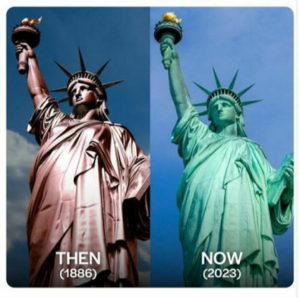
The Statue of Liberty was made with copper but due to oxidation, it turned green.

When the “Lady in the Harbor” first arrived in New York in 1886, she didn’t look like the mint-green icon we know today. In fact, for the first twenty years of her life, she stood as a towering, metallic beacon of reddish-gold. Designed by French sculptor Frédéric Auguste Bartholdi and engineered by Alexandre Gustave Eiffel, the statue was a gift from France to America. To build her, Bartholdi chose copper for three practical reasons:

  • Malleability:It could be hammered into elaborate, thin sheets.
  • Weight:Copper is lighter than stone or bronze, making it easier to ship 350 individual pieces across the Atlantic.
  • Durability:It was strong enough to survive a 27-day ocean voyage and the harsh winds of the harbor.

When she was unveiled on October 28, 1886, her skin—made of 300 copper sheets roughly the thickness of two pennies—shone with a bright, metallic brown luster. The transformation from “penny-colored” to “patina-green” wasn’t planned. Bartholdi actually expected the statue to age into a deeper, darker red. However, the unique environment of New York Harbor—a mix of salt air, moisture, and industrial pollution—triggered a process called oxidation.

The Timeline of Change:

  1. 1886–1900:The bright copper dulled into a dark, muddy brown.
  2. 1903:The first hints of a light green crust, or “patina,” began to appear.
  3. 1906:The color change was so controversial that Congress nearly stepped in. They appropriated $62,000 to paint the statue back to its original color, but the public protested, calling the idea “sacrilege.”
  4. 1910–1920:The statue was a patchy mix of brown and green until 1920, when the oxidation was complete, leaving her entirely teal.

While we now view the green color as iconic, it actually serves a vital structural purpose. The layer of verdigris (the green patina) acts as a protective shield. It seals the copper underneath, preventing the metal from further corrosion and weathering.  By the time the color fully changed, a new generation of immigrants had arrived in America seeing a green statue.