Learners Live

AI Is Outpacing America’s Power Grid. Nuclear Must Become a National Priority by Mark Whitney

Nuclear energy is an immediate, national strategic imperative. Advanced nuclear technologies, including smaller, faster-to-build reactors, deliver reliable, scalable and zero-carbon power. Unlike wind or solar, nuclear operates 24/7, which is exactly what hyperscale AI data centers require. The early movers are acting:

The message is clear: secure dependable, carbon-free power now, or face capacity shortages and rising costs. AI is outpacing America’s power grid. Nuclear must become a national priority. | Utility Dive

Meta to Build $10B AI Data Center in Northeast Louisiana

A transformational investment that cements the state’s status as a major innovation hub and puts this picturesque rural community on the leading edge of a global digital revolution. Meta projects the data center will support 500 or more direct new jobs in Richland Parish. Louisiana Economic Development (LED) estimates the project will result in the creation of more than 1,000 indirect jobs, for a total of more than 1,500 potential new jobs in the Northeast Region. The company estimates 5,000 construction workers at peak of construction on the 2,250-acre former Franklin Farm megasite that sits between the municipalities of Rayville and Delhi, about 30 miles east of Monroe. Meta to Build $10B AI Data Center in Northeast Louisiana – electrifiED
Meta and NVIDIA Announce Long-Term Infrastructure Partnership

The large-scale deployment of NVIDIA technology builds on our existing relationship and will support Meta’s build-out of data centers optimized for AI training and inference, as well as our core business. These advances will also deliver substantial improvements in performance per watt, supporting more efficient AI operations at scale. Meta has also adopted:

  • NVIDIA Confidential Computing for WhatsApp private messaging, enabling AI-powered capabilities across the messaging platform, while ensuring user data confidentiality and integrity.
  • NVIDIA Spectrum-X Ethernet networking platform across its infrastructure footprint to provide AI-scale networking, delivering predictable, low-latency performance while maximizing utilization and improving both operational and power efficiency.

As part of this multi-generational collaboration, engineering teams across Meta and NVIDIA will optimize and accelerate state-of-the-art AI models across our core workloads to drive performance and efficiency for new AI capabilities used by billions around the world.

[News] Meta and NVIDIA Announce Long-Term Infrastructure Partnership – LEDinside

Guess How Much Big Tech Will Spend on AI This Year

Four of the largest tech companies in the world project that they’ll spend roughly $650 billion combined on AI infrastructure in 2026, representing a historic ball-out for corporate capital expenditures, Bloomberg reported Here’s who’s spending what:

  • Taking the cake, Amazon announced Thursday that it’s planning to drop $200 billion on AI, chips, robotics, and satellites.
  • A day earlier, Alphabet said its capital expenditures could reach $185 billion, blowing past estimates.
  • Last week, Meta pegged its capex as high as $135 billion—an 87% jump from the year prior—driven by the company’s goal of achieving AI superintelligence.
  • Microsoft is expected to spend nearly $105 billion during its fiscal year ending in June.

Big Tech to spend $650 billion on AI in 2026, per Bloomberg

Meta to Spend $600bn on US Data Centers by 2028

Meta claims it will spend $600 billion on digital infrastructure in the US over the next three years. Data centers are “crucial” to helping the company reach its goal of “building superintelligence for everyone” and “helping America maintain its technological edge,” the post said. Quite how Meta intends to fund this is unclear. The company posted annual revenue of $62.3 billion in 2024, and $600 billion figure is more than double the amount the firm has made during its 15 years as a public company. Meta has around 30 data center campuses in operation or development globally. Meta to spend $600bn on US data centers by 2028 – DCD

Cheyenne to Host Massive AI Data Center Using More Electricity than All Wyoming Homes Combined

An artificial intelligence data center that would use more electricity than every home in Wyoming combined before expanding to as much as five times that size will be built soon near Cheyenne, according to the city’s mayor. With cool weather — good for keeping computer temperatures down — and an abundance of inexpensive electricity from a top energy-producing state, Wyoming’s capital has become a hub of computing power. The city has been home to Microsoft data centers since 2012. An $800 million data center announced last year by Facebook parent company Meta Platforms is nearing completion. The latest data center, a joint effort between regional energy infrastructure company Tallgrass and AI data center developer Crusoe, would begin at 1.8 gigawatts of electricity and be scalable to 10 gigawatts. A gigawatt can power as many as 1 million homes. But that’s more homes than Wyoming has people. The least populated state, Wyoming, has about 590,000 people. But this proposed data center is so big, it would have its own dedicated energy from gas generation and renewable sources.  Cheyenne to host massive AI data center using more electricity than all Wyoming homes combined | AP News

The Push to Triple Global Nuclear Energy by 2050

In recent years, the world has faced unprecedented growth in energy demand caused by digitalization, the development of artificial intelligence, electric vehicles, and other energy-consuming technologies. In an attempt to handle this challenge, Amazon, Meta, and Google — top stock gainers during previous years — as well as 14 leading banks and financial institutions, energy suppliers, and representatives of heavy industry, have joined forces to achieve the ambitious goal of tripling global nuclear power capacity by 2050. The World Nuclear Association initiated this program — for the first time, companies not directly involved in nuclear energy have publicly supported scaling nuclear power plants to meet their needs.  Powering the Future: The Push to Triple Global Nuclear Energy by 2050 – Programming Insider

The AI Data-Center Boom Is Coming to America’s Heartland by Jennifer Hiller

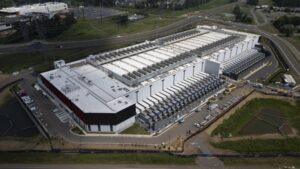
Meta and other tech companies are scouring rural America for land, transmission lines and natural gas. Meta Platformsscooped up 2,700 acres of farmland last year for what would be its largest-ever data center, built over flat rice fields 45 minutes west of the Mississippi River.  At 4 million square feet, or 70 football fields, Meta’s data center will cost $10 billion and sit on more acreage than Louisiana State University in Baton Rouge, which has more than 34,000 students. Building advanced artificial-intelligence systems will take city-sized amounts of power, which has turbocharged electricity demand projections for the first time this century. The AI Data-Center Boom Is Coming to America’s Heartland – WSJ

Meta’s Dual-Brand Smart Glasses: Oakley for Performance, Ray-Ban Goes High-End

Meta is expanding its smart glasses lineup with fresh offerings under both the Oakley and Ray-Ban brands—two labels united under Luxottica. Ray-Ban Meta smart glasses offer hands-free photo and video capture and voice-activated AI assistance. The new Oakley smart glasses designed with athletes and fitness enthusiasts in mind, feature a reconfigured camera mounted at the center of the frame to improve balance and tracking accuracy during high-intensity activities like cycling or running. Introducing Hypernova: The Premium Upgrade:  Hypernova will feature a display on the bottom of the right lens, where information is directly projected into the wearer’s field of view, nudging the device closer to being a lightweight, wearable computer that might one day rival smartphones. While standard Ray-Ban Meta glasses are priced at around $299, Hypernova could fetch nearly $1,000 due to its advanced features. https://www.ledinside.com/news/2025/2/2025_02_17_02

Why Amazon, Microsoft, Google and Meta Are Investing in Nuclear Power

Tech leaders are exploring nuclear power as a solution to the massive energy needs of their data centers, sustainability challenges, and the growing demands of their AI initiatives. SMRs, a new type of nuclear reactor, are gaining attention for their ability to provide round-the-clock power with minimal emissions. As some of the largest energy users, major tech companies are investing in these reactors, which could play a key role in global energy transformation. A must watch video:  Why Amazon, Microsoft, Google and Meta are investing in nuclear power | Watch

The Statue of Liberty was made with copper but due to oxidation, it turned green.

When the “Lady in the Harbor” first arrived in New York in 1886, she didn’t look like the mint-green icon we know today. In fact, for the first twenty years of her life, she stood as a towering, metallic beacon of reddish-gold. Designed by French sculptor Frédéric Auguste Bartholdi and engineered by Alexandre Gustave Eiffel, the statue was a gift from France to America. To build her, Bartholdi chose copper for three practical reasons:

  • Malleability:It could be hammered into elaborate, thin sheets.
  • Weight:Copper is lighter than stone or bronze, making it easier to ship 350 individual pieces across the Atlantic.
  • Durability:It was strong enough to survive a 27-day ocean voyage and the harsh winds of the harbor.

When she was unveiled on October 28, 1886, her skin—made of 300 copper sheets roughly the thickness of two pennies—shone with a bright, metallic brown luster. The transformation from “penny-colored” to “patina-green” wasn’t planned. Bartholdi actually expected the statue to age into a deeper, darker red. However, the unique environment of New York Harbor—a mix of salt air, moisture, and industrial pollution—triggered a process called oxidation.

The Timeline of Change:

  1. 1886–1900:The bright copper dulled into a dark, muddy brown.
  2. 1903:The first hints of a light green crust, or “patina,” began to appear.
  3. 1906:The color change was so controversial that Congress nearly stepped in. They appropriated $62,000 to paint the statue back to its original color, but the public protested, calling the idea “sacrilege.”
  4. 1910–1920:The statue was a patchy mix of brown and green until 1920, when the oxidation was complete, leaving her entirely teal.

While we now view the green color as iconic, it actually serves a vital structural purpose. The layer of verdigris (the green patina) acts as a protective shield. It seals the copper underneath, preventing the metal from further corrosion and weathering.  By the time the color fully changed, a new generation of immigrants had arrived in America seeing a green statue.